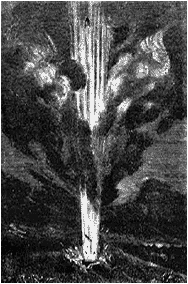
Jules Verne’s
Moon gun, as described in his 1865 novel From
the Earth to the Moon. It consisted of a cannon 274 m long with a
bore of 2.74 m cast in a vertical well in Florida. The first 61 m of the
barrel was filled with 122 tons of guncotton which, when ignited, was
supposed to propel an aluminum capsule (containing three men and two dogs)
to a speed of 16.5 km/s. After deceleration through Earth’s atmosphere,
the shell would have a residual velocity of 11 km/s – sufficient to reach
the Moon.
Although Verne made some scientific errors, he used real engineering
analysis to arrive at the design of his cannon and lunar projectile. In
this passage from his book he provides extensive detail:
During the eight months which were employed in
the work of excavation the preparatory works of the casting had been
carried on simultaneously with extreme rapidity. A stranger arriving at
Stones Hill would have been surprised at the spectacle offered to his
view. At 600 yards from the well, and circularly arranged around it as a
central point, rose 1,200 reverberating ovens, each six feet in
diameter, and separated from each other by an interval of three feet.
The circumference occupied by these 1,200 ovens presented a length of
two miles. Being all constructed on the same plan, each with its high
quadrangular chimney, they produced a most singular effect. It will be
remembered that on their third meeting the committee had decided to use
cast iron for the Columbiad, and in particular the white description.
This metal, in fact, is the most tenacious, the most ductile, and the
most malleable, and consequently suitable for all moulding operations;
and when smelted with pit coal, is of superior quality for all
engineering works requiring great resisting power, such as cannon, steam
boilers, hydraulic presses, and the like. Cast iron, however, if
subjected to only one single fusion, is rarely sufficiently homogeneous;
and it requires a second fusion completely to refine it by dispossessing
it of its last earthly deposits. So long before being forwarded to Tampa
Town, the iron ore, molten in the great furnaces of Coldspring, and
brought into contact with coal and silicium heated to a high
temperature, was carburized and transformed into cast iron. After this
first operation, the metal was sent on to Stones Hill. They had,
however, to deal with 136,000,000 pounds of iron, a quantity far too
costly to send by railway. The cost of transport would have been double
that of material. It appeared preferable to freight vessels at New York,
and to load them with the iron in bars. This, however, required not less
than sixty- eight vessels of 1,000 tons, a veritable fleet, which,
quitting New York on the 3rd of May, on the 10th of the same month
ascended the Bay of Espiritu Santo, and discharged their cargoes,
without dues, in the port at Tampa Town. Thence the iron was transported
by rail to Stones Hill, and about the middle of January this enormous
mass of metal was delivered at its destination. It will easily be
understood that 1,200 furnaces were not too many to melt simultaneously
these 60,000 tons of iron. Each of these furnaces contained nearly
140,000 pounds weight of metal. They were all built after the model of
those which served for the casting of the Rodman gun; they were
trapezoidal in shape, with a high elliptical arch. These furnaces,
constructed of fireproof brick, were especially adapted for burning pit
coal, with a flat bottom upon which the iron bars were laid. This
bottom, inclined at an angle of 25 degrees, allowed the metal to flow
into the receiving troughs; and the 1,200 converging trenches carried
the molten metal down to the central well. The first
person to think of using a cannon to put a projectile in orbit was Isaac
Newton
in his Principia Mathematica. For more details on this, see Newton's
orbital cannon. See also space cannon.
|