|
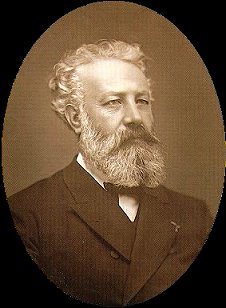
Born in Nantes and trained in law, Verne may not have been the first science fiction writer (Lucian, Mary
Shelley, and Edgar Allan Poe all having prior claims to that accolade)
but he was certainly the first to explore the genre systematically and to make a
fortune from it. Although he must have been familiar with the enthusiasm of his
Parisian contemporary Flammarion
for the possibility of life on other worlds, Verne barely touches upon the alien
theme in his novels. The one minor exception is to be found in his only
extraterrestrial venture, From the
Earth to the Moon (1865) and its sequel Around the Moon. In the
latter, he exploits Hansen's hypothesis that the Moon's far-side has an
atmosphere, water and, possibly, life. His astronauts glimpse "... real seas,
oceans, widely distributed, reflecting on their surface all the dazzling magic
of the fires of space; and, lastly, on the surface of the continents, large dark
masses, looking like immense forests ..." In other respects, his lunar novels
remarkably presaged Apollo, even to the extent of describing a three-man crew, a
Florida launch site and a splashdown point in the Pacific just three miles from
where Apollo 11 landed. All Verne's early novels captured the Victorian
enthusiasm for science and technology, though the optimistic ideology in them
may have stemmed more from the urging of Verne's publisher, the
commercially-minded Pierre-Jules Hetzel, than Verne himself who seems by nature
to have been a techno-skeptic.
|