|
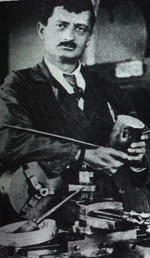
- Hermann Oberth was born on June 25, 1894 in Hermannstadt, Transylvania, Romania. Since he was born to German speaking parents and became a German citizen later in life, Oberth is traditionally considered German
even though he was born in Romania.
- Like Robert Goddard, Oberth became fascinated with the possibility of spaceflight at the age, by reading science fiction works by authors such as Jules Verne's From The
Earth To The Moon. By the age of 14, he had already envisioned a “recoil rocket” that could propel itself through a vacuum by
expelling exhaust gases from a liquid fuel. He realized early on, too, that staging was the key to accelerating rockets to high speed.
He was brought up in an academic environment, and eventually became a teacher in Transylvania. In 1912, Oberth enrolled in the
University of Munich to study medicine and later served with a medical unit in World War I.
- Early in his career, Oberth expressed fanciful views on rocketry and spaceflight, but later began a scientific analysis on the reaction principle. It was just prior to World War I that he became interested in war rocketry.
During the war years, however, he realized that his future lay in a different direction and upon returning to the University of Munich, he took up physics.
- In 1917, Oberth proposed to the German War Department the development of liquid-fueled long-range bombardment missiles. The idea, which could have placed Oberth years ahead of Robert Goddard in the launching of a liquid-fueled rocket, was rejected by the German military out of hand.
- Several years later, Oberth learned of the existence of a 1919 book by Robert Goddard entitled “A Method Of Reaching Extreme Altitudes” but was unable to locate a copy in Germany.
In 1922, Oberth wrote to Goddard and suggested that the development of liquid-fueled rockets should be an international endeavor.
His doctoral thesis, in which he described a liquid-propellant rocket, was rejected as being too unorthodox. However, Oberth published it
privately the following year as a 92-page pamphlet entitled Die Rakete zu den Planetenräumen (The Rocket into Interplanetary Space) which set forth the basic principles of spaceflight.
The book included a disclaimer which stated that any similarities between his theories and the 1919 book by Robert Goddard were purely by coincidence.

|
- The book contained theories on rocketry similar to those of Goddard, but also included speculation on the effects of spaceflight on the human body. Oberth also put forth later proven theories that a rocket could travel faster than its own exhaust and could
operate in a vacuum. He also theorized on the possibility of placing satellites in space.
Oberth never admitted borrowing any of his ideas from Goddard, and claimed to have engaged in extensive research of his own. Whether or not this was true, Oberth was able to gain the necessary momentum to stimulate German experiments in liquid-fueled rocketry.
Operating under the Newtonian premise that a rocket could carry a payload into Earth-orbit if it could fly fast enough and high enough, Oberth began to experiment with a number of propellants.
- He designed a basic rocket, called “Modell B” which could be used in high-altitude research. Oberth also considered the merits of using a mixture of alcohol and hydrogen as rocket fuels.
A much-expanded version, entitled “Wege Zur Raumschiffahrt” (The Road To Space Travel), appeared in 1929 to international acclaim and served to inspire many subsequent spaceflight pioneers.
This, coupled with distribution of his earlier work, did much to stimulate interest in rocketry throughout Germany and Europe.
- Also in 1929, Oberth joined Verein Fur Raumschiffahrt (Society for Space Travel) and became its president.
- Unlike Robert Goddard, Oberth made every practical effort to publicize his work. He became technical advisor to the Ufa Film Company and director Fritz Lang, who was filming a movie entitled “Frau Im Mond” (Girl In The Moon). Oberth was commissioned to construct a rocket which
would be launched in a publicity stunt for the movie.
Aided by a young and eager scientist named Wernher von Braun, Oberth was able to construct and static test a small rocket engine on July 23, 1930. But it quickly became apparent that a rocket would not be available in time for the release of the movie, and the project was abandoned.
After this project fizzled, Oberth returned to teaching in Transylvania. In the years following World War II, Oberth came to the United States to work with his former student Wernher von Braun at the Army Ballistic Missile Agency.
When it became clear that he would lose his German pension if he stayed in the United States too long, Oberth returned to Germany where he continued to author books on rocketry and space travel.
While his practical experiments in rocketry were few, he remains credited with encouraging many talented scientists to enter the field of rocketry.
- Unlike Robert Goddard, Oberth was not slow in seeking publicity for his work.
In the same year his enlarged treatise went on his sale, he became technical
advisor for the film Frau Im Mond (Woman in the
Moon) and was commissioned to build a rocket that would be sent up as a
publicity stunt. Aided by the young Werner von Braun,
Oberth managed to build and statically test a small rocket engine - a risky
laboratory exercise in which he lost the sight in his left eye. But when it
became clear that the rocket would not be ready to launch in time for the
movie’s release, the project was abandoned and, shortly after, Oberth returned
to teaching in Transylvania.
Following World War II, Oberth came to the United States to work again with
his former student, von Braun, at the Army Ballistic
Missile Agency. However, three years later Oberth returned to Germany to
continue to write books on rocketry and space travel.
- Along with Konstantin
Tsiolkovsky and Robert
Goddard, he is considered to be one of the founding fathers of modern rocketry.
|
Ref.: #95, www.spaceline.org - update: 24.10.25
|
Home |
|