The famous novel by Jules Verne in
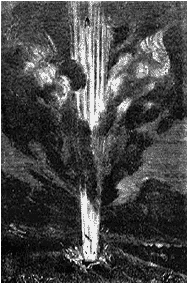
which a capsule containing three men and two dogs is blasted out of an immense
cannon, the Columbiad,
toward the Moon. From the Earth to the Moon1 (1865) and its
sequel Around the Moon2 (1870) are packed with technical
details some of which, it was realized at the time of the Apollo
8 and 11 missions, were curiously prescient. In the story, as in reality, the
United States launched the first manned vehicle to circumnavigate the Moon.
Verne gave the cost of his project as $5,446,675—equivalent to $12.1 billion in
1969 and close to Apollo 8′s price tab of $14.4 billion. Both fictional and real
spacecraft had a crew of three: Ardan, Barbicane, and Nicholl in the novel,
Anders, Borman, and Lovell on Apollo 8, and Aldrin, Armstrong, and Collins on
Apollo 11. Both spacecraft were built mainly of aluminum and had similar dry
masses—8,730 kg in the case of Verne′s capsule, 11,920 kg in the case of Apollo
8. The cannon used to launch the spacecraft was the Columbiad; Apollo
11′s Command Module was named Columbia. After considering 12 sites in
Texas and Florida, Stone Hill, south of Tampa, Florida is selected in Verne′s
novel. One hundred years later NASA considered seven launch sites and chose
Merritt Island, Florida. In both cases Brownsville, Texas was rejected as a
site, politics played a major role in the site selection, and site criteria
included a latitude below 28° N and good access to the sea.
Verne′s spacecraft was launched in December,
from latitude 27° 7′ N, longitude 82° 9′ W. After a journey of 242 hours 31
minutes, including 48 hours in lunar orbit, the spacecraft splashed down in the
Pacific at 20° 7′ N, 118° 39′ W, and was recovered by the United States Navy
vessel Susquehanna. The crew of Apollo 8 was launched in December 100 years
later, from latitude 28° 27′ N, longitude 80° 36′ W, 213 km from Verne′s site.
After a journey of 147 hours 1 minute, including 20 hours 10 minutes in lunar
orbit, the spacecraft splashed down in the Pacific (8° 10′ N, 165° 00′ W) and
was recovered by the United States Navy vessel Hornet.
Although space cannons are still considered a viable means of launching small satellites,
Verne was wildly optimistic in supposing that men and dogs (not to mention some
chickens that Arden smuggled aboard with the idea of releasing them on the Moon
to astonish his friends) could survive the horrendous g-forces associated
with being accelerated almost instantly to escape velocity out of a giant gun.
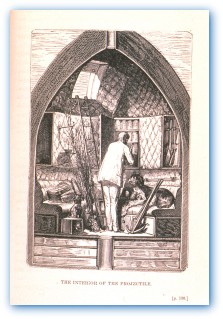
The ingenious system of hydraulic shock absorbers Barbican had devised for the
floor of the projectile would have done nothing to save the occupants (only one
of which, the dog Satellite, fails in the novel to survive the launch). Verne
also took a liberty with the crew's means of disposing of the dead animal: by
opening a hatch in the capsule "with the utmost care and dispatch, so as to lose
as little as possible of the internal air." Aside from these technical
implausibilities, Verne′s most significant scientific error was his treatment of
weightlessness. He believed it occurred only at the neutral point of gravity
between Earth and the Moon, and thus allowed his crew only about one hour of it
during their flight. But in terms of luxury, Verne′s capsule beat Apollo
hands-down: "even the Pullman cars of the Pacific Railroad could not surpass the
projectile vehicle in solid comfort" and at the moment of greatest crisis on the
return journey Arden is able to settle the crew's nerves with some bottles of
Tokay Imperial 1863.
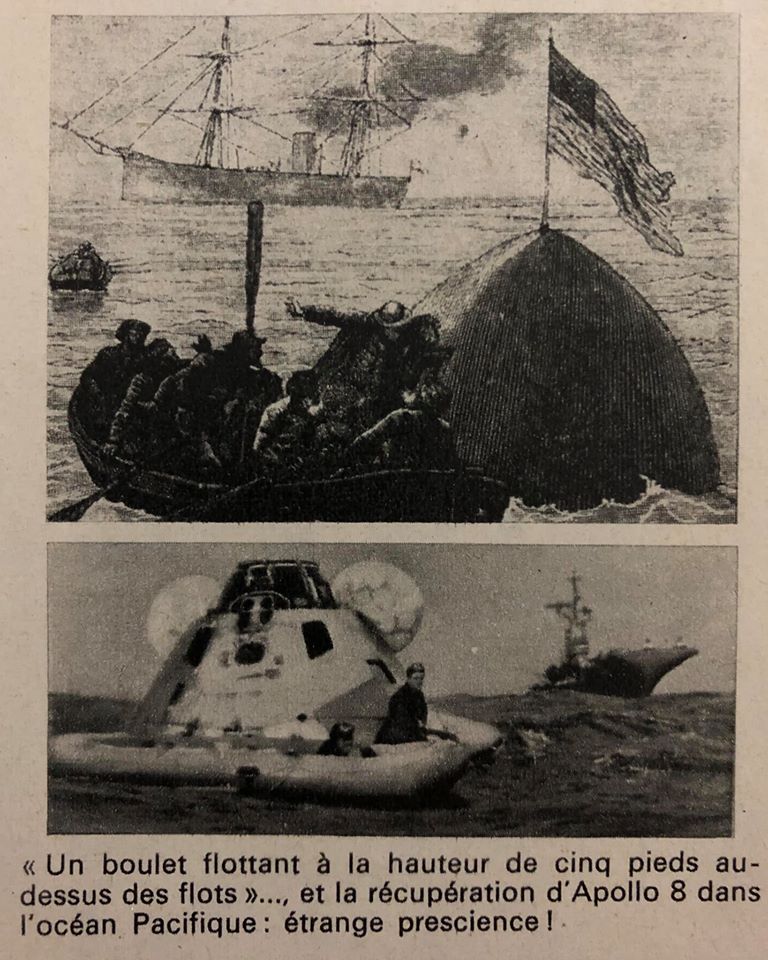
′A floating ball at the height of five feet above the waves′ ....., and the recovery of Apollo 8 in the
Pacific Ocean: a strange prescience!