Manned Flight n°: 153 |
Earth orbit Flight n°: 150 |
USA manned Flight n°: 80 |
Launch, orbit & landing data:
| Designation | 22064 / 92049A |
| Launch date - time | 31 Jul 1992 - 13:56:48 UT |
| Launch site | KSC, LC39B |
| Launch vehicle |
Space Shuttle |
| Orbiter | Atlantis OV-104 (#12) |
| Primary payload | Eureca 1 |
| Mass (kg) | |
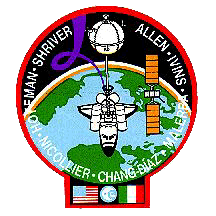
| Flight Crew | Shriver, Allen, Nicollier, Ivins
Hoffman, Chang-Diaz, Malerba |
| Call Sign | |
| Earth orbit on : |
| - Perigee / Apogee | km |
| - Inclination | 28.45° |
| - Period | min |
| Landing date - time | 08 Aug 1992 - 13:11:51 UT |
| Landing location | KSC, Runway 33 |
| Flight Duration (d:hr:min) | 7d 23h 15m |
| Nbr orbits | 127 |
|
|
Crew
| Nr. |
Surname |
Given name |
Job |
Duration |
| 1 |
Shriver |
Loren James |
CDR |
7d 23h 15m |
| 2 |
Allen |
Andrew Michael |
PLT |
7d 23h 15m |
| 3 |
Hoffman |
Jeffrey Alan |
MSP |
7d 23h 15m |
| 4 |
Chang-Diaz |
Franklin Ramon |
MSP |
7d 23h 15m |
| 5 |
Nicollier |
Claude |
MSP |
7d 23h 15m |
| 6 |
Ivins |
Marsha Sue |
MSP |
7d 23h 15m |
| 7 |
Malerba |
Franco Egidio |
PSP |
7d 23h 15m |
Mission details:
Launch from Cape Canaveral (KSC); landing on Cape
Canaveral (KSC); deployment of ESA's European Retrievable Carrier (EURECA)
was successfull after a few problems; deployment of joint NASA-Italian
Space Agency Tethered Satellite System (TSS-1); maximum distance only 860
feet because of jammed tether line; TSS-operations were then stopped and
the satellite was succesful stowed for return to Earth; several secondary
payloads.
31 July 1992
13:57 GMT. Duration: 7.97 days.Agency: U.S. Air Force.Payload: Atlantis F12 / Eureca 1 / TSS 1. Mass: 12,965 kg. Perigee: 425 km. Apogee: 437 km. Inclination: 28.5 deg. Period: 93.2 min.
Manned seven crew. Deployed Eureca-1; failed to deploy Italian tether probe TSS-1. Payloads: Tethered Satellite System (TSS)-1; European Retrievable Carrier (EURECA)-1L; Evaluation of Oxygen Integration with Materials (EOlM)-lll/ Thermal Energy Management Processes (TEMP)-2A; Consortium for Materials Development In Space Complex Autonomous Payloads (CONCAP)-ll and Ill; IMAX Cargo Bay Camera (ICBC); Limited Duration Space Environment Candidate Materials Exposure (LDCE); Pituitary Growth Hormone Cell Function (PHCF); Ultravio-let Plume Instrument (UVPl).
Orbits of Earth: 127. Distance traveled: 5,344,642 km. Orbiter Liftoff Mass: 116,133 kg. Orbiter Mass at Landing: 94,711 kg. Payload to Orbit: 12,965 kg. Payload Returned: 8,434 kg. Landed at: Runway 33 at Kennedy Space Center, Florida. Landing Speed: 378 kph. Touchdown miss distance: 594 m. Landing Rollout: 3,310 m.
NASA Official Mission NarrativeMission Name: STS-46 (49)
Atlantis (12)
Pad 39-B (20)
49th Shuttle Mission
12th Flight of OV-104
KSC Landing (11)
Crew:
Loren J. Shriver (3), Commander
Andrew M. Allen (1), Pilot
Jeffrey A. Hoffman (3), Mission Specialist 1
Franklin R. Chang-Diaz (3), Mission Specialist 2
Claude Nicollier (1), Mission Specialist 3
Marsha S. Ivins (2), Mission Specialist 4
Franco Malerba (1), Payload Specialist 1
Milestones:
OPF1 - 4/2/92
VAB - 6/4/92
PAD - 6/11/92
Payload:
TSS-1,EURECA-II,LDCE,PHCF,UVPI,IMAX-06,EOIM-III/TEMP-2A,CONCAP-II,ICBC,
AMOS
Mission Objectives:
Launch: July 31, 1992, 9:56:48 a.m. EDT. Launch Weight: 256,031 lbs.
Orbit:
Altitude: 230 nm
Inclination: 28.45 degrees
Orbits: 127
Duration: 7 days, 23 hours, 15 minutes, 3 seconds.
Distance: 3,321,007 miles
Hardware:
SRB: BI-052
SRM: 360W/L025
ET : 50/LWT-43
MLP : 1
SSME-1: SN-2032
SSME-2: SN-2033
SSME-3: SN-2027
Landing:
August 8, 1992, 9:11:50 a.m. EDT, Runway 33, Kennedy Space Center. Rollout distance: 10,860 feet. Mission extended one day to complete scientific objectives. Landing Weight: 208,806 lbs.
Mission Highlights:
Mission's primary objectives were the deployment of ESA's European Retrievable Carrier (EURECA) and the joint NASA/Italian Space Agency Tethered Satellite System (TSS). EURECA was deployed a day later than scheduled because of a problem with its data handling system. Seven and a half hours after deployment, the spacecraft's thrusters were fired to boost EURECA to its planned operating altitude of around 31O miles. However, thruster firing was cut to six minutes from 24 minutes because of unexpected attitude data from the spacecraft. The problem was resolved and EURECA was successfully boosted to its operational orbit on the mission's sixth day. TSS deployment also was delayed one day because of the problems with EURECA. During deployement, the satellite reached a maximum distance of only 86O feet from the orbiter instead of the planned 12.5 miles because of a jammed tether line. After numerous attempts over several days to free the tether, TSS operations were curtailed and the satellite was stowed for return to Earth. Seconday payloads included: Evaluation of Oxygen Integration with Materials/Thermal Management Processes (EOIM-III/TEMP 2A), Consortium for Materials Development in Space Complex Autonomous Payload (CONCAP II and CONCAP III), IMAX Cargo Bay Camera (ICBC), Limited Duration Space Environment Candidate Materials Exposure (LDCE), Air Force Maui Optical Site (AMOS), Pituitary Growth Hormone Cell Function (PHCF), and Ultraviolet Plume Instrument (UVPI). Mission extended extra day to complete scientific objectives.
|
Ref.: #1, #7, #8, #16 - update: 20.03.06
|
Home |