|
No one would have believed, in the last years of the nineteenth century, that human affairs were being watched keenly and closely by intelligences greater than man's ...Cleverly, Wells weaves scientific fact into his tale so that the reader is left wondering where the real world ends and glimpses of another possible truth begin. Some familiar names make their appearance:
Men like Schiaparelli watched the red planet - it is odd, by the by, that for countless centuries Mars has been the star of war—but failed to interpret the fluctuating appearances of the markings they mapped so well. All the time the Martians must have been getting ready. During the opposition of 1894 a great light was seen on the illuminated part of the disc, first at the Lick Observatory, then by Perrotin of Nice . . . I am inclined to think that the appearance may have been the casting of the huge gun [a borrowing from Verne] ... from which their shots were fired at us.Swept aside here is the heroic, isolated, near-human race of Lowell. In its place is a truly alien species with an intellect "vast and cool and unsympathetic." As for the anatomy of this other-world creature, Wells had already warned in an earlier article to expect a nasty shock. Now the thing was revealed:
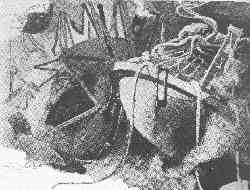
A big, greyish rounded bulk, the size, perhaps of a bear, was rising slowly and painfully out of the cylinder. As it bulged up and caught the light, it glistened like wet leather. Two large dark-coloured eyes were regarding me steadfastly. The mass that framed them, the head of the thing, it was rounded, and had, one might say, a face. There was a mouth under the eyes, the lipless brim of which quivered and panted, and dropped saliva. The whole creature heaved and pulsated convulsively. A lank tentacular appendage gripped the edge of the cylinder, another swayed in the air.With his appreciation of how living things were shaped and selected by their circumstances, Wells realized that where life arose on other planets it would develop to suit the local conditions, such as gravitational pull and atmospheric make-up. Therefore it would not be easy for a creature that had evolved in one place to adjust to the environment elsewhere:
Those who have never seen a living Martian can scarcely imagine the strange horror of their appearance. The peculiar V-shaped mouth with its pointed upper lip, the absence of brow ridges, the absence of a chin beneath the wedge-like lower lip, the incessant quivering of this mouth, the Gorgon groups of tentacles, the tumultuous breathing of the lungs in a strange atmosphere, the evident heaviness and painfulness of movement, due to the greater gravitational energy of the earth—above all, the extraordinary intensity of the immense eyes —culminated in an effect akin to nausea. There was something fungoid in the oily brown skin ... Even at this first encounter, this first glimpse, I was overcome with disgust and dread.
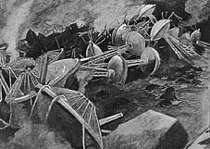 |
Partly this urge to grab new resources and strategic land around the world was a response to instabilities within Europe itself. And so Wells was able to touch another raw nerve. Throughout the latter part of the nineteenth century, the continent was in a perpetual state of tension, its major powers playing a dangerous game of shifting alliances and rivalries. War never seemed more than a careless gunshot away. It might even come from the air given that gas balloons had been used by the Germans during the siege of Paris in 1870. So, just as Lowell's concept of a worldwide canal network and giant pumping stations had seemed all the more credible (and was conceived) against a backdrop of rapid engineering and industrial progress, it was to a public all too familiar with news of international unrest and threats of invasion that Wells directed his menacing tale.
Until The War of the Worlds, stories of visitors to Earth had generally portrayed the outsiders as gentle, peace-lovers, interested only in watching us, perhaps with mild amusement or concern (see Micromegas). But in Wells's novel, the extraterrestrials are painted suddenly in an altogether different light: as a terrifying threat, capable of bringing merciless death and destruction. No human weapon could stand against them, any more than a spear or shield could provide protection against a gun. Wells showed how pathetically helpless we would be if a malignant alien race, centuries ahead of us, did decide to attack the Earth. And in doing this he caused something to stir that had been buried deep within our animal subconscious—the naked fear of the prey when confronted by the irresistible predator. To Technological Man the effect of this sudden exposure to a long-suppressed dread was devastating. Humankind had begun to imagine it was secure in its role as master of the planet. But Wells revealed how feeble our tenure might be should superior beings from elsewhere choose to come and wrest control of the Earth away from us.
Speculation about the Martian canals and their creators had titillated public interest. But the idea of invasion from space had an altogether more serious and long-lasting effect. It buried itself like a barbed sting beneath the surface of popular culture, so that it would be felt in future whenever there came a hint of the possibility of alien incursion.