A program to study the upper
atmosphere using instrumented projectiles shot from a cannon, conducted in
the 1960s by researchers at McGill University, Montreal. The projectiles
were cylindrical finned missiles, 20 cm wide and 1.7 m long, with masses
of 80-215 kg called Martlets, from an old name for the martin bird which
appears on McGill's shield. The cannon that propelled the Martlets was
built by Canadian engineer Gerald Bull from
two ex-United States Navy 16-inch- (41-cm-) caliber cannon connected
end-to-end. Located on the island of Barbados, it fired almost vertically,
out over the Atlantic. Inside the barrel of the cannon, a Martlet was
surrounded by a machined wooden casing known as a sabot which traveled up
the 16-m-long barrel at launch and then split apart as the Martlet headed
upward at about 1.5 km/s having undergone an acceleration of
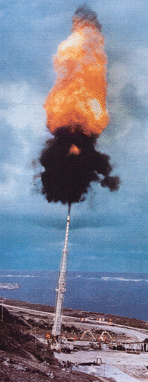
25,000g. Each shot produced a huge explosion that could be heard
all over Barbados and a plume of fire rising hundreds of meters into the
air. The Martlets carried payloads of metal chaff, chemical smoke, or
meteorological balloons and were fitted with telemetry antennas for
tracking their flight.
By the end of 1965, HARP had fired more
than a hundred missiles to heights of over 80 km. In Nov. 19, 1966, the
Army Ballistics Research Laboratory used a HARP gun to launch an 84-kg
Martlet to an altitude of 179 km – a world record for a fired projectile
that still stands.
|