The X-8 was conceived to fulfill a requirement for a relatively inexpensive upper air research vehicle and sounding rocket. Most X-8
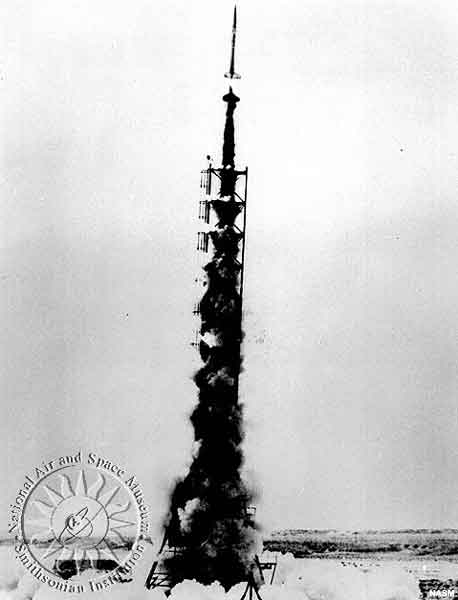
flights were conducted at either the White Sands Missile Range, or nearby Holloman AFB, New Mexico. The missile was launched from a 143-foot
high tower elevated at an angle of approximately 87 degrees.
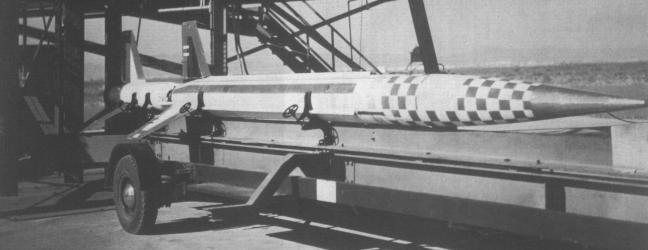
The standard X-8 vehicle consisted of a payload section with the experimental package, a parachuterecovery system, a
liquid-fueled sustainer engine, stabilizing fins, and a solid-fueled booster engine.
The payloads carried by the X-8 varied considerably from mission to mission, but on the average weighed about 150 pounds. During the course
of the X-8 program, data was obtained on high-altitude winds, solar radiation, high-altitude temperatures, cosmic radiation, the earth′s
magnetic field, warhead trajectories, effects of high-altitude on warhead design, propulsion anomalies at high altitudes, vehicle dynamics, and general
atmospheric phenomenon.
A total of 108 vehicles were manufactured for both the Air Force and the Navy: 68 X-8s, 34 X-8As, 1 X-8B, 2 X-8Cs, and 3 X-8Ds. But perhaps
more significantly, the type directly spawned the Aerobee sounding rocket, of which more than 800 were eventually manufactured and used by both
military and civilian agencies around the country. Perhaps not surprisingly, no X-8s are known to have survived. However, numerous Aerobee
rockets are on display around the country and are generally similar in appearance.
Aerojet X-8 (RTV-A-1)
An X-8 accelerates from its launch tower at Holloman AFB under the
power of its booster rocket.