By NASA Press Release
posted: 11:25 am ET
30 April 2001
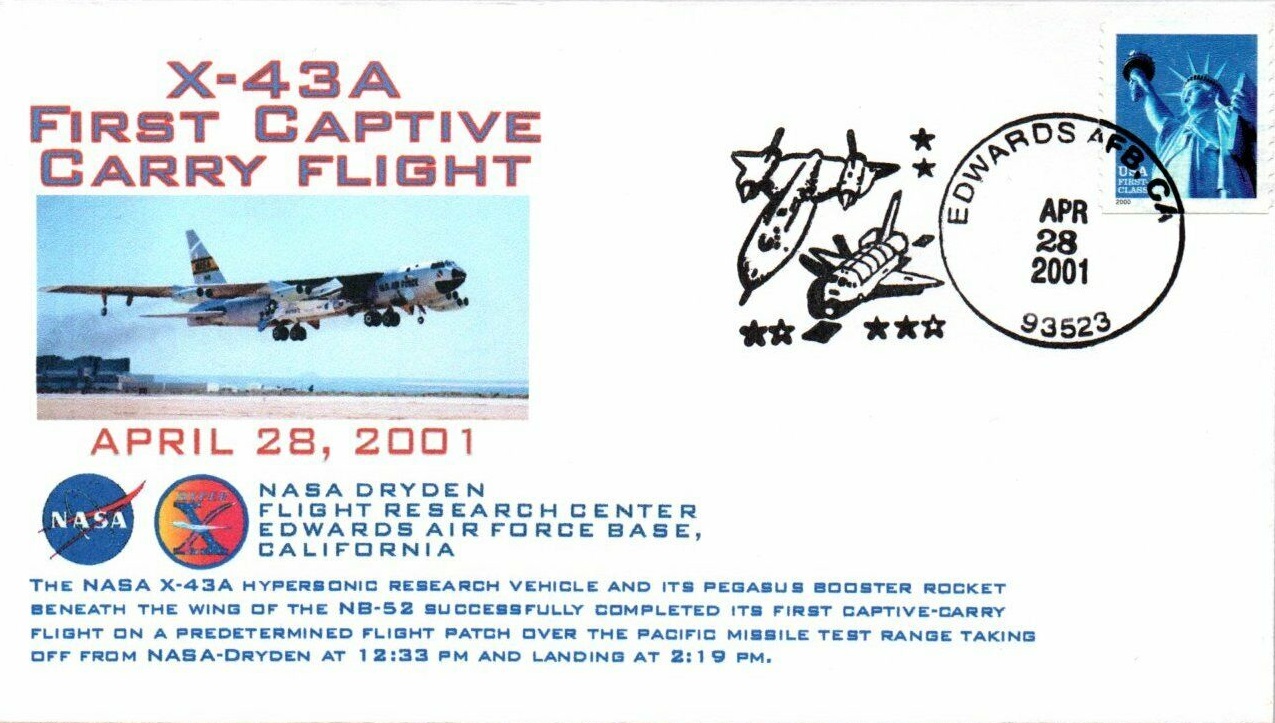
The NASA X-43A hypersonic research vehicle and its Pegasus booster rocket, mounted beneath the wing of their B-52 mother ship, had a successful first captive-carry
flight this afternoon. A dress rehearsal for the subsequent free flight, the captive-carry flight kept the X-43A-and-Pegasus combination attached to the B-52′s
wing pylon throughout the almost two-hour mission from NASA′s Dryden Flight Research Center, Edwards, California, over the Pacific Missile Test Range, and back
to Dryden.
After taking off from the Dryden Flight Research Center, Edwards, California, at 3:33 p.m. EDT (19:33 GMT), the B-52 soared off the California coast on the predetermined
flight path, and returned to Dryden for a 5:19 p.m. EDT (21:19 GMT) landing.
The pilotless X-43A marks the return to dedicated hypersonic research flights (at least five times the speed of sound) that NASA last pursued with the X-15 program
that ended in 1969. Unique to the X-43A is its blending of an integrated airframe with a scramjet (supersonic combustion ramjet) engine, intended to make the X-43A the
first air-breathing hypersonic vehicle in free flight. This technology promises significant savings in weight and volume, which could translate into heavier payloads
or longer flight duration for future scramjet operational craft.
Pending thorough evaluation of all flight data, this captive-carry test could lead to the first flight of the X-43A "stack" as early as mid May. The first free
flight will be air-launched by NASA's B-52 at about 24,000 feet (7,315 meters) altitude. The booster will accelerate the X-43A to Mach 7 and to approximately 95,000
feet (28,955 meters) altitude. At booster burnout, the X-43 will separate from the booster and fly under its own power on a preprogrammed flight path. The hydrogen-fueled
aircraft has a wingspan of approximately 5 feet (1.5 meters), measures 12 feet (3.7 meters) long and weighs about 2,800 pounds (1,270 kilograms).
Three X-43A flights are planned -- the first two will fly at Mach 7 and the third at Mach 10. Valuable performance data will be relayed electronically to Dryden
and Langley. Each experimental aircraft will fly once in the Naval Air Warfare Center Weapons Division Sea Range off the southern coast of California and impact into
the Pacific Ocean.
A scramjet-based propulsion system could decrease propellant system weight and increase payload -- or maintain the same payload using a smaller, cheaper vehicle.
Scramjet technology could also allow "aircraft-like" operations of launch vehicles with horizontal takeoff, landing and servicing that could greatly decrease operations
cost and time between flights.
NASA′s Dryden Flight Research Center is responsible for X-43A flight-testing and NASA's Langley Research Center, Hampton, Virginia, manages the program. The
vehicle contractor team led by MicroCraft in Tullahoma, Tennessee includes The Boeing Co., Seal Beach, California and GASL, Inc., Ronkonkoma, New York. The booster is
a modified Pegasus rocket from Orbital Sciences Corp., Chandler, Arizona.