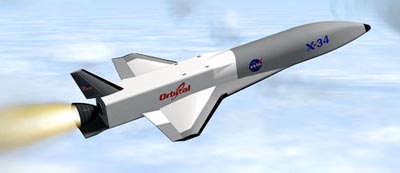
The X-34 was a reusable testbed vehicle designed to demonstrate technologies that were considered essential to
lowering the cost of access to space. Specific technologies to be demonstrated by the X-34 included advanced
composite structures, a composite RP-1 fuel tank, an advanced thermal protection system, and autonomous flight
operations. The all-composite vehicle was designed for speeds up to Mach 8 and altitudes of 250,000 feet.
The first of three X-34 vehicles began captive-carry flights at Edwards AFB, in June 1999 using the L-1011 TriStar
owned by Orbital Sciences. At this point the first flight was scheduled for late 2000. The initial free flights were to
be made over the White Sands Missile Range, with the full-performance flights taking place over the Atlantic Ocean
off the Kennedy Space Center in Florida. A special hangar was constructed at Kennedy to support the program, and
was later used to house debris from the Space Shuttle Columbia accident. Although the program appeared to be progressing
satisfactorily, revisions to the requirements led to significant cost growth and schedule slip. In March 2001
NASA cancelled the X-34 program before any of the aircraft had actually flown except under the L-1011.
Technical Data:
Manufacturer:
Orbital Sciences Corporation
Operator:
NASA
Length :
m
Heigh:
m
Span:
m
Weight (kg):
-
Rocket motor:
Thrust:
-
Flights
None, cancelled
X-34
Notes:
NASA failed to attract industry co-investment to develop an X-34 air-launched, reusable, low-technology, low-cost launch vehicle. So the project was scaled
back and NASA contracted with Orbital Sciences to build and fly an unmanned technology demonstrator. Objectives were to demonstrate new, efficient vehicle processing
and launch operations and evaluate the performance of advanced reusable launch vehicle technologies. The program was to demonstrate a nominal two-week turnaround
between flights, and a surge capability of two flights within 24 hours. The single stage vehicle used NASA′s low cost Fastrac engine for liquid oxygen/kerosene
propulsion. The vehicle itself used all-composite primary and secondary structure. Its autonomous flight control system was to make automated approach and landings.
Flights were planned to speeds of Mach 8 over an 800 km range. The contract with Orbital Sciences covered construction of three flight vehicles and 26 powered and
unpowered flights launched from an L-1011.
Payload: 400 kg. to a: Mach 8, 76 km trajectory. trajectory. Liftoff Thrust: 27,423 kgf. Total Mass: 26,500 kg. Total Length: 17.7 m.
Gross Mass: 21,800 kg. Empty Mass: 8,200 kg. Thrust (vac): 27,423 kgf. Isp: 310 sec. Burn time: 150 sec. Span: 8.5 m.
Length: 17.7 m.
Propellants: Lox/Kerosene, No Engines: 1. Fastrac.