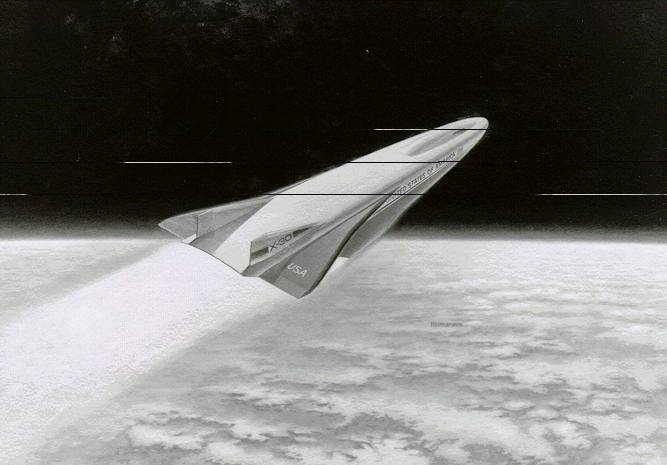
The program to develop what was called the National Aero-Space Plane (NASP) had its roots in a highly classified
Defense Advanced Research Projects Agency (DARPA) project called Copper Canyon that ran from 1982 to 1985.
Originally conceived as a feasibility study for a single-stage-to-orbit (SSTO) vehicle that could take off and land
horizontally, Copper Canyon became the starting point for what Ronald Reagan called “… a new Orient Express
that could, by the end of the next decade, take off from Dulles Airport and accelerate up to twenty-five times the
speed of sound, attaining low earth orbit or flying to Tokyo within two hours…” It was not to be.
In an ambitious program that involved every major aerospace company in the United States, DARPA proposed
building a prototype NASP designated X-30. Unfortunately, the X-30 ran into significant cost and technical difficulties,
resulting in its cancellation. The Hypersonic Systems Technology Program (HySTP), initiated in late 1994,
was designed to transfer the accomplishments made in hypersonic technologies by the NASP program into a technology
development program. The X-43A Hyper-X is one of the results of the HySTP program.
Technical Data:
Manufacturer:
National Team
Operator:
DARPA, USAF, NASA
Length :
m
Heigh:
m
Span:
m
Weight (kg):
-
Flights
None
X-30 configuration. Credit: NASA.
Notes:
Air-breathing scramjet single stage to orbit. Second attempt after study of similar proposal in early 1960′s. Cancelled due to cost, technical challenges.
Liftoff Thrust: 140,000 kgf. Total Mass: 140,000 kg. Core Diameter: 16.0 m. Span: 36m. Total Length: 96.0 m. Development Cost $: 3,000.00 million. in 1985 average dollars.
Propellants: Air/Slush LH2 No Engines: 1. Scramjet