Description:
- Vulcan Centaur is a heavy-lift launch vehicle[a] developed and operated by United Launch Alliance (ULA). It is a two-stage-to-orbit launch vehicle consisting of the Vulcan first stage and the Centaur V second stage. Replacing ULA's Atlas V and Delta IV rockets, the Vulcan Centaur is principally designed to meet the needs of the National Security Space Launch (NSSL) program, which supports U.S. intelligence agencies and the Defense Department, but ULA believes it will also be able to price missions low enough to attract commercial launches. ULA began development of the new launch vehicle in 2014, primarily to compete with SpaceX’s Falcon 9 and to comply with a Congressional mandate to phase out the use of the Russian-made RD-180 engine that powered the Atlas V. The first launch of the Vulcan Centaur was initially scheduled for 2019 but faced multiple delays due to developmental challenges with its new BE-4 first-stage engine and the Centaur second-stage.
- The Vulcan Centaur had a near perfect first launch on January 8, 2024, carrying the Peregrine lunar lander, the first mission of NASA's Commercial Lunar Payload Services program. Its second launch, a NSSL certification flight, took place on October 4, 2024, which achieved an acceptable orbital insertion, despite the nozzle on one of the GEM-63XL solid rocket boosters falling off which led to reduced, asymmetrical thrust. Following a five-month review of the launches, the Space Force certified the Vulcan for U.S. NSSL missions in March 2025.
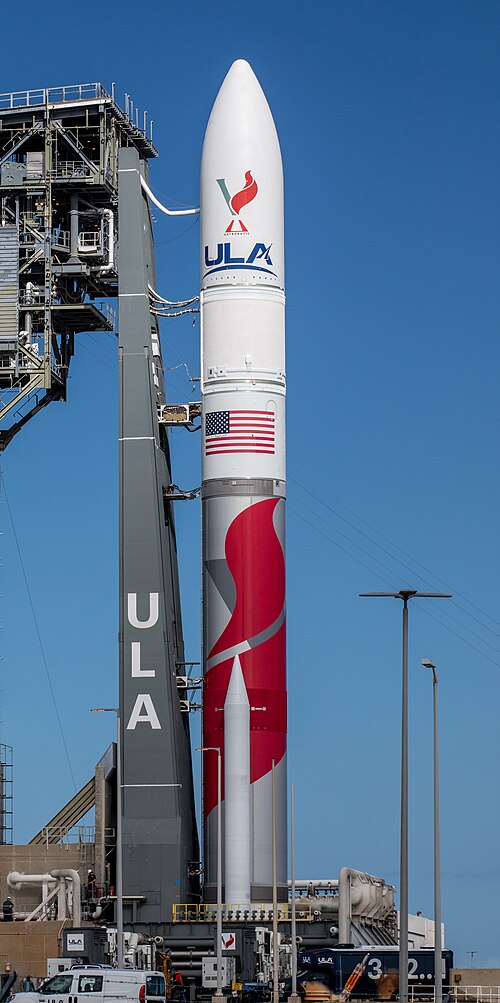
05.01.2024: rolled out of the Vertical Integration Facility