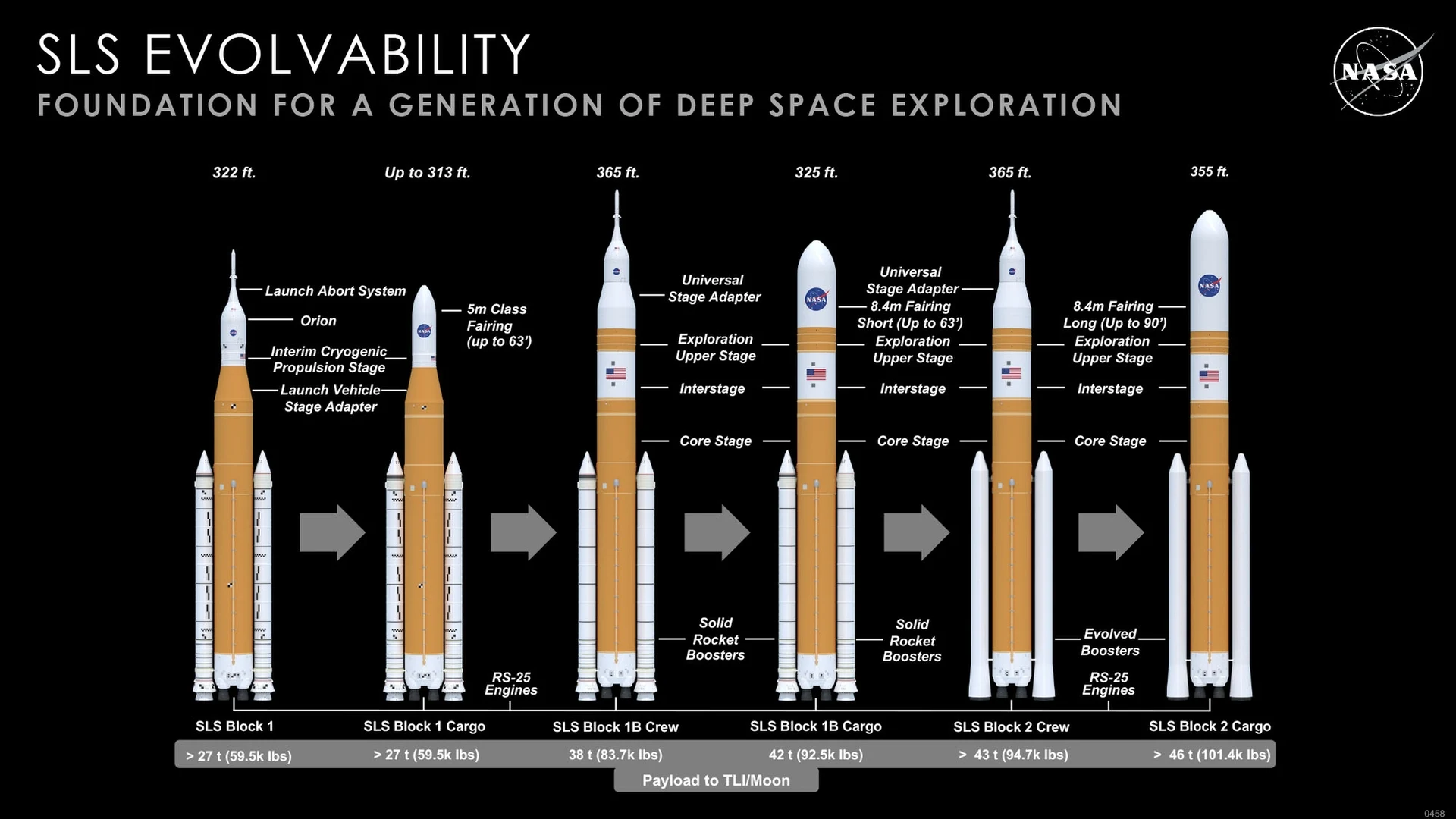
| Manufacturer: |
Aerojet Rocketdyne, Boeing, Northrop Grumman, United Launch Alliance |
|---|
| Function: |
Super heavy-lift launch vehicle |
|---|
| Height: |
98 m |
|---|
| Diameter: |
8,4 m |
|---|
| Mass: |
2,610,000 kg |
|---|
| Stages: |
2 1/2 |
|---|
| Max thrust: |
39 MN |
|---|
| Payload to LEO: |
|
|---|
| Altitude: |
28.5° |
|---|
| Mass: |
95,000 kg |
|---|
| Payload to TLI: |
|
|---|
| Mass: |
27,000 kg |
|---|
|
| Boosters: |
five-segment SRB |
|---|
| Height: |
54 m |
|---|
| Diameter: |
3.7 m |
|---|
| Gross mass: |
730,000 kg |
|---|
| Max thrust: |
SL: 14.6 MN
vac: 16MN |
|---|
| Total thrust/th>
| SL: 29.2 MN
vac: 32 MN |
|---|
| Specific impulse: |
269 s (2.64 km/s) |
|---|
| Burn time: |
126 sec |
|---|
| Propellant: |
APCP (AI/AP/PBAN) |
|---|
| First stage - Core |
|
|---|
| Height |
64.6 m |
|---|
| Diameter |
8.4 m |
|---|
| Empty mass |
97,940 kg |
|---|
| Gross mass |
1,085,410 kg |
|---|
| Propellant mass |
LH2: 144,000 kg
LOX: 840,000 kg |
|---|
| Powered by |
4x RS-25 |
|---|
| Max thrust |
SL: 7.4 MN
vac: 9.1 MN |
|---|
| Specific impulse |
SL: 366 s
vac: 452 s |
|---|
| Burn time |
480 sec |
|---|
| Propellant |
LH2 / LOX |
|---|
| Second stage |
ICPS |
|---|
| Height |
13.7 m |
|---|
| Diameter |
LH2 tank: 5 m
LOX tank: 3.2 m |
|---|
| Empty mass |
3,490 kg |
|---|
| Gross mass |
32,066 kg |
|---|
| Powered by |
1x RL10 |
|---|
| Max thrust |
110.1 kN |
|---|
| Specific impulse |
465.5 s |
|---|
| Burn time |
1,125 sec |
|---|
| Propellant |
LH2/LOX |
|---|
| First Flight |
|
|---|
| Last Flight |
|
|---|
| Total Flights |
|
|---|
| Fastest Flight |
|
|---|
| Highest Flight |
|
|---|
|