R-7 family of launchers and ICBMs |
Russia |
Different versions of space launch vehicles derived from the R-7 ICBM:
|
Type
|
Manufacturer
index
|
US
designation
|
Sheldon
designation
|
Developer
|
Payloads
|
| Sputnik |
8K71PS
|
SL-1
|
-
|
OKB-1
|
Sputnik-1 |
| Luna/Vostok |
8K72
|
SL-3
|
A-1
|
OKB-1
|
Luna,
Vostok |
| Vostok |
8K72K
|
SL-3
|
A-1
|
OKB-1
|
Vostok |
| Vostok-2 |
8K72V
|
SL-3
|
A-1
|
OKB-1
|
- |
| Vostok-2M |
8K72V1
|
SL-3
|
A-1
|
OKB-1
|
Elektron,
Meteor |
| Vostok-2M |
8K72V3
|
SL-3
|
A-1
|
OKB-1
|
Elektron,
Meteor |
| Vostok-2M |
8K72D
|
SL-3
|
A-1
|
OKB-1
|
Elektron,
Meteor |
| Vostok-2M |
8K72-2D
|
SL-3
|
A-1
|
OKB-1
|
Elektron,
Meteor |
| Luna |
8K73/73E
|
SL-3
|
A-1
|
OKB-1
|
E-3
project |
| Sputnik |
8A91
|
SL-3
|
A-1
|
OKB-1
|
Object
D (Sputnik-3) |
| Vostok |
8A92
|
SL-3
|
A-1
|
OKB-1
|
Zenit-2 |
| Vostok |
8A92M
|
SL-3
|
A-1
|
OKB-1
|
Meteor,
IRS-1A, Intercosmos-Bulgaria |
| Vostok |
8A92ME
|
SL-3
|
A-1
|
OKB-1
|
Meteor,
Tselina-D |
| Vostok |
8A92V3
|
SL-3
|
A-1
|
OKB-1
|
Zenit-2 |
| Vostok |
8A93
|
SL-3
|
A-1
|
OKB-1
|
OD-2 |
| Vostok |
11A92
|
SL-3
|
A-1
|
OKB-1
|
Zenit-2 |
| Molniya |
8K78
|
SL-6
|
A-2-e
|
OKB-1
|
Molniya,
Mars/Venera, Prognoz, Zond |
| Molniya |
8K78-MV
|
SL-6
|
A-2-e
|
OKB-1
|
Mars/Venera,
Prognoz, Zond |
| Molniya |
8K78-2MV
|
SL-6
|
A-2-e
|
OKB-1
|
Mars/Venera,
Prognoz, Zond |
| Molniya |
8K78-E6
|
SL-6
|
A-2-e
|
OKB-1
|
Luna
(E-6) |
| Molniya |
8K78M
|
SL-6
|
A-2-e
|
TsSKB
|
Mars/Venera,
Prognoz, Zond 1-3 |
| Polet |
8A92
|
SL-5
|
-
|
OKB-1
|
IS |
| Voskhod |
11A57
|
SL-4
|
A-2
|
OKB-1
|
Voskhod,
Zenit |
| Voskhod |
11A59
|
SL-4
|
A-2
|
OKB-1
|
Zenit-2 |
| Voskhod |
11A510
|
SL-4
|
A-2
|
OKB-1
|
Zenit-4 |
| Soyuz |
11A511
|
SL-4
|
A-2
|
TsSKB
|
Soyuz |
| Soyuz |
11A511M
|
SL-4
|
A-2
|
TsSKB
|
Yantar |
| Soyuz-U |
11A511-U
|
SL-4
|
A-2
|
TsSKB
|
Soyuz-TM |
| Soyuz-U2 |
11A511-U
|
SL-4
|
A-2
|
TsSKB
|
Progress-M |
| Soyuz-U2 |
11A511K
|
SL-4
|
A-2
|
TsSKB
|
Resurs/
Soyuz-TM |
| Soyuz-2
(Rus) |
-
|
SL-4
|
A-2
|
TsSKB
Progress
|
Soyuz-2 |
| Soyuz-Irene |
-
|
SL-4
|
A-2
|
Arianespace
|
Globalstar
(project) |
| Soyuz-Ikar
|
-
|
SL-4
|
A-2
|
Starsem
|
Globalstar |
| Soyuz-Fregat |
-
|
SL-4
|
A-2
|
Starsem
|
Cluster,
IRDT |
| Soyuz-ST |
-
|
SL-4
|
A-2
|
Starsem
|
- |
| Yamal |
-
|
SL-4
|
A-2
|
RKK
Energia
|
Enterprise,
ISS modules |
| Raduga |
-
|
SL-4
|
A-2
|
RKK
Energia
|
- |
Versions of the R-7 ICBM:
|
|
Manufacturer
index
|
US
designation
|
NATO
designation
|
Developer
|
Description
|
| R-7 |
8K71
|
SS-6
|
Sapwood
|
OKB-1
|
Original
ICBM |
| R-7A |
8K74,
8K710
|
SS-6
|
Sapwood
|
OKB-1
|
In armaments
since 1960 |
| - |
8K73
|
-
|
-
|
OKB-1
|
Project
of ICBM |
| - |
8K711
|
SS-6
|
Sapwood
|
OKB-1
|
Project
of ICBM |
| - |
8K712
|
SS-6
|
Sapwood
|
OKB-1
|
Project
of ICBM |
| R-8 |
-
|
-
|
-
|
OKB-456
|
Glushko's
alternative to R-7 |
Base R-7
rocket (two booster stages) tech dossier:
|
Number
of stages
|
2
|
|
Length
of the vehicle
|
|
|
Diameter
|
10.3-11.2
meters at the base of four strap-on boosters
|
|
Weight
(fueled)
|
280
tons (empty weight: 27 tons)
|
|
Fuel
|
Kerosene
T-1
|
| Oxidizer |
Liquid
Oxygen |
| Weight
of propellant |
253
tons |
| First
launch |
1957 |
| Launch
sites |
Tyuratam
(two pads), Plesetsk (four pads) |
|
|
8,500-8,800
(8,000) km
|
|
Warhead
type (single):
|
KB-11-developed
- 5,300-5,500-kg, 7.27-meter, 3-5 megaton, thermonuclear
|
|
Accuracy
|
2.5-5.0
kilometers (max. deviation 10 kilometers)
|
|
Officially
in armaments
|
R-7
(8K71) since January 20, 1960 until mid-1960s
|
| Stage
1 |
Four
strap-on booster (Blocks B, V, G, D) |
| Stage
1 weight |
170
tons
|
| Stage
1 length |
19.2
meters
|
| Stage
1 diameter |
2.68
meters |
| Stage
1 burn time |
104-130
seconds from launch |
| 1st
stage propulsion |
- 1
x four-chamber main engine RD-107 (8D74)
- 2
x one-chamber steering engines
|
| Stage
2 |
Core
(Block A) |
| Stage
2 weight (fueled) |
93.36
tons
|
| Stage
2 dry weight |
6.465
tons
|
| Stage
2 length |
28
meters
|
| Stage
2 diameter |
2.95
meters |
| Stage
2 burn time |
285-320
seconds |
| 2nd
stage propulsion |
- 1
x four-chamber main engine RD-108 (8D75)
- 1
x four-chamber steering engine
|
| Launch
system |
ground-based:
Tyulpan (8U215)
|
| Storage
time (fueled) |
30 days
|
| Readiness
time |
2 hours
|
The R-7
development cooperation:
| Element
|
Developer |
Chief-designer |
Location |
| Overall
design |
OKB-1
|
S.P.
Korolev
|
Podlipki
(Korolev)
|
| Production
(initial) |
Zavod
#88
|
-
|
Podlipki
(Korolev)
|
| Production
(serial) |
Zavod #1 Progress
|
D.I.
Kozlov
|
Kyibushev
(Samara)
|
| Propulsion
units (both stages) |
OKB-456
|
V.
Glushko
|
Moscow
|
| Control
system |
NII-885
|
N.
Pilugin
|
Moscow
|
| Launch
complex (surface) |
KB-59
Kompressor
|
V.P.Barmin
|
Moscow
|
The R-7 was the biggest leap in the world's rocketry since German V-2. Ironically,
developed as the first Soviet ICBM, the R-7 had became obsolete as a weapon
before it started flying. Yet, as a launch-vehicle it continued serving
the Russian space program almost half a century after it was originally
conceived. At the turn of the 21st century, the R-7-derived space boosters
have remained the only vehicles delivering Russian manned spacecraft into
orbit. Moreover, the construction of the International Space Station would
also depend on the R-7-based boosters launching the supply ships and lifeboats
for the outpost's crews.
APPENDIX
Early milestones in the R-7 program:
March
3, 1957: The first R-7 missile (Number 5L) arrived to Tyuratam.
May 5,
1957, early morning local time: The first R-7 missile (Number 5L)
was rolled to the launch pad.
May 15,
1957, 19:00 local time: The first R-7 launch from Baikonur.
June 10-11,
1957: Three attempts to launch R-7 rocket (Number M1-6). The missile
remained on the pad due to technical problems. Removed from the pad.
July 12,
1957: 15:53 local time: The R-7 rocket (Number M1-7) launch from Baikonur.
The vehicle disintegrated at 32.9 seconds in flight. The debris crashed
about 7 kilometers downrange.
August
21, 1957, 15:25 local time: The R-7 rocket (Number M1-9) launch from
Baikonur. Flight went normally, but the warhead disintegrated at the altitude
of 10 kilometers over Kamchatka Peninsula.
August
27, 1957, TASS officially announced
about "creation of a long-range multistage ballistic missile in the
Soviet Union." The announcement remained largely unnoticed in the
West.
September
7, 1957, 14:39 local time: The first R-7 (Number M1-10) launch from
Baikonur. Flight went normally, but the warhead section apparently collided
with the core stage during the separation and disintegrated again during
the reentry.
October
4, 1957, 22:28:34 Moscow time (00:28:34 local time on October 5):
The R-7 rocket (Number 8K71PS) launched world's first artificial satellite
PS-1 or Sputnik-1 from Baikonur.
November
3, 1957, 05:30:42 Moscow time: The R-7 rocket launched Sputnik-2 carrying
dog Laika onboard from Baikonur. Laika died three days after the launch
from overheating of her cabin. The spacecraft had no reentry system onboard.
December
22, 1957: The R-7 rocket (8K71 Number 11) arrived to Baikonur.
December
31, 1957, The attempt to launch a test R-7 rocket was delayed.
January
30, 1958, 00:15 local time: Test launch of the R-7 rocket (8K71 Number
11) with warhead M1-12.
PICTURE
GALLERY

On a foggy morning in October 2000, the Soyuz booster was being prepared
for the launch of the first resident crew of the International Space Station,
more than 43 years after the original version of the rocket flew.

Soyuz-Fregat version of the Soyuz launch vehicle is being prepared in Baikonur.

A close up view of the core-stage engine on the Soyuz rocket.

The assembly of the second and third stages of the Soyuz launcher.
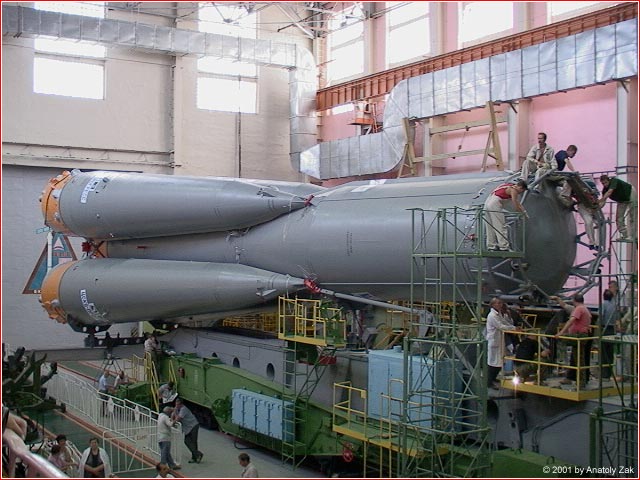
Four strap-on boosters and a central core stage of the R-7 rocket.
|