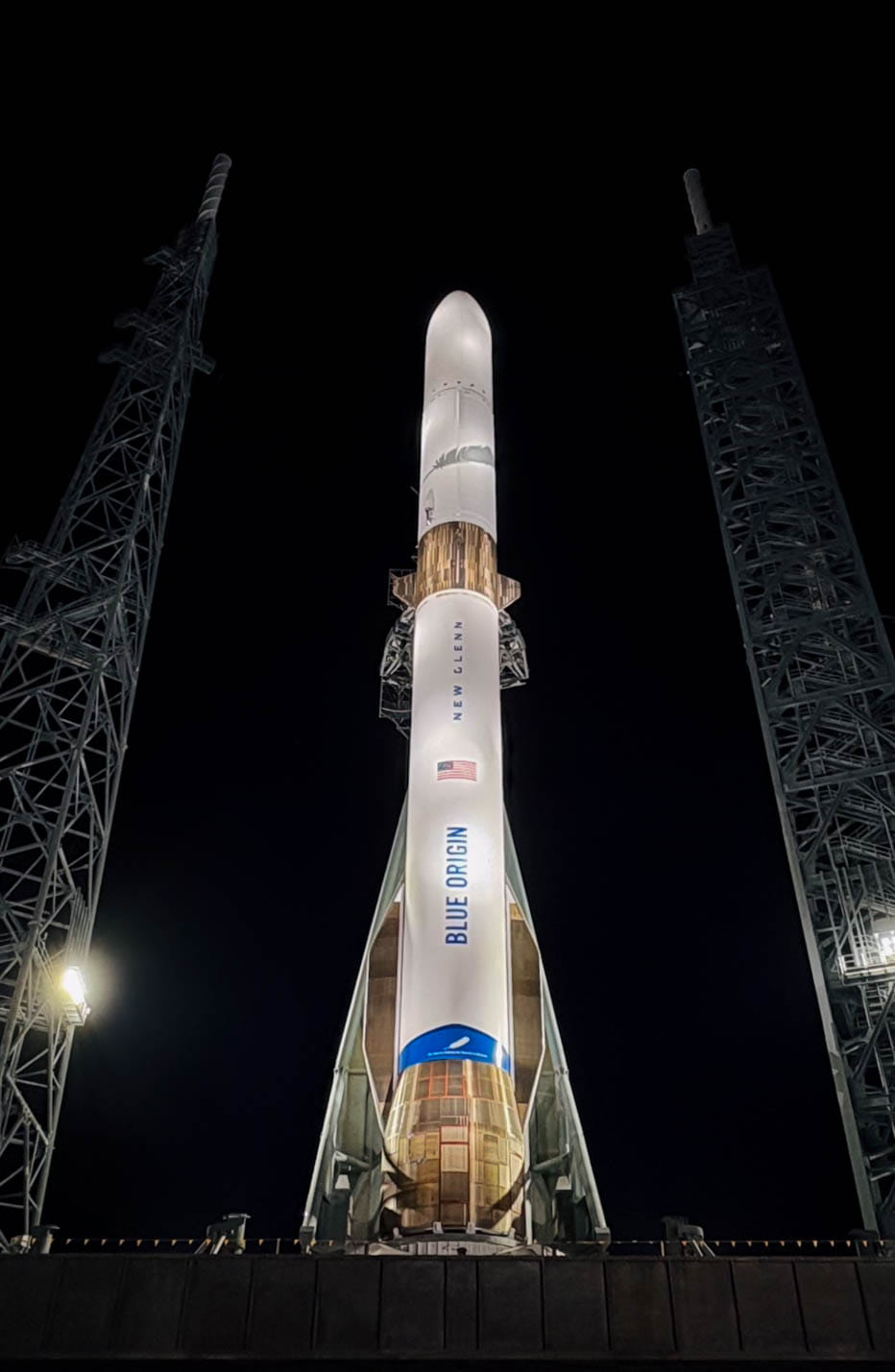
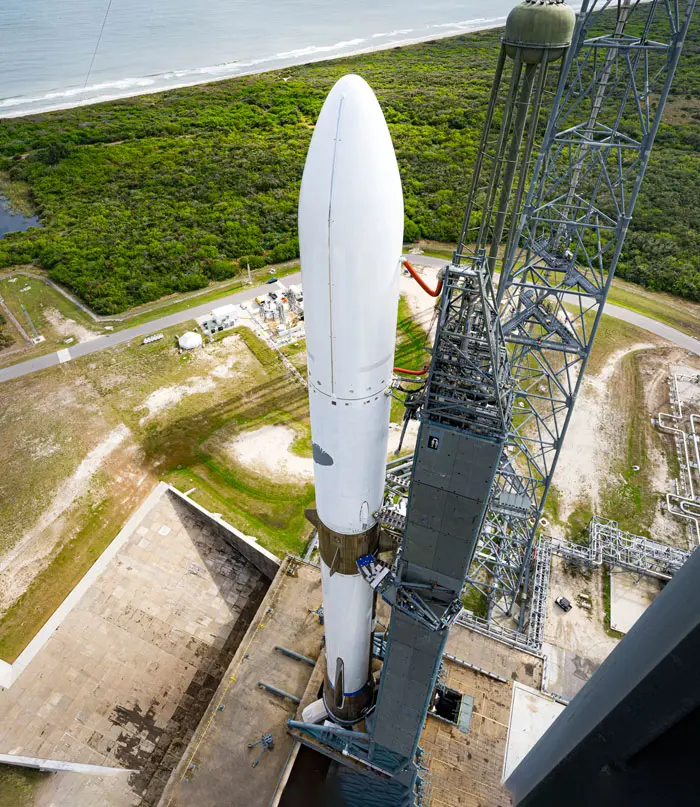
New Glenn is a heavy-lift launch vehicle developed by Blue Origin, named after NASA astronaut John Glenn, the first American
astronaut to orbit the Earth. It flew to space on its maiden flight on January 16, 2025.
Descriptions & Technical Data:
New Glenn is a 7 m (23 ft) diameter two-stage orbital launch vehicle with a reusable first stage[18] and an expendable second stage.
An optional third stage was envisaged with a single BE-3U engine, and was planned as of October 2018.
The first stage (GS1) is designed to be reusable for a minimum of 25 flights, and lands vertically, a technology previously developed by
Blue Origin and tested in 2015–2016 on its New Shepard suborbital launch vehicle. The second stage (GS2) shares the same diameter and is "roughly
88 feet (26.8 meters) tall" and is expendable. Both stages use orthogrid aluminum tanks with welded aluminum domes and common bulkheads. Both
stages also use autogenous pressurization.
The first stage is powered by seven BE-4 methane/oxygen engines—designed
and manufactured by Blue Origin—producing 17,000 kN (3,800,000 lbf) of liftoff thrust. Its liquid oxygen propellant tank has a volume of 30,000
cu ft (850 m3) while the fuel tank can store almost 25,000 cu ft (710 m3) of liquid methane.
The second stage is powered by two BE-3U vacuum optimized engines,
also designed and manufactured by Blue Origin, using hydrogen/oxygen as propellants.
The company stated in 2019 that the planned full operational payload capacity of the two-stage version of New Glenn would be 13,000 kg (29,000 lb)
to GTO and 45,000 kg (99,000 lb) to a 51.6° inclined LEO, though the initial operating capability could be somewhat lower. As of 2018, dual-satellite
launches were intended to be offered after the first five flights.
Launches of New Glenn are made from the Cape Canaveral Space Force Station in Florida, with Launch Complex 36 (LC-36) leased to Blue Origin in 2015
in support of the New Glenn program. As of 2023, Blue Origin and the U.S. Space Force plan to give New Glenn polar orbit capabilities through building
a West Coast launch facility at Vandenberg Space Force Base in California, to be called Space Launch Complex 9 (SLC-9).
The first stage boosters of New Glenn are intended to be reusable, and were originally intended to be recovered downrange on the Atlantic Ocean
via their landing platform ship Jacklyn, which would have acted as a floating movable landing platform. The hydrodynamically stabilized
ship would have increased the likelihood of successful recovery in rough seas. That ship was scrapped, and a new landing barge named
Landing Platform Vessel 1, also nicknamed Jacklyn, was commissioned and became operational in 2024.
Launch preparations:
As of September 2024, the debut launch was planned to be a demonstration launch for the United States Space Force's National
Security Space Launch program, carrying the Blue Ring Pathfinder. The booster for the flight was named So You're Telling Me There's a
Chance, alluding to the difficulty of landing a reusable booster on the first attempt.
Testing continued in October 2024 with successful hot fire tests of the second stage. The completed first stage (GS1) moved to the
launchpad on October 30, 2024, ahead of the first flight.
The Flight 1 vehicle was moved to the launchpad on November 20, 2024, for static fire testing. Full wet dress rehearsal occurred on
December 19, 2024, and a 24-second static fire was conducted on December 27.
On January 13, 2025, Blue Origin conducted their first launch attempt with the vehicle. After several slips in the countdown, the attempt
was scrubbed at approximately 3:05 AM EST (0805 UTC).
On January 16, 2025, 2:03 AM EST (0703 UTC), New Glenn launched for the first time. Blue Origin reached orbit on its first attempt,
injecting the GS-2 upper stage and the Blue Ring Pathfinder payload into medium earth orbit. Blue Origin stated that GS-1, the first stage of
New Glenn, was lost on descent. Telemetry showed that the booster was traveling at an approximate speed of Mach 5.5 at an altitude of 84,226 ft (25.7 km) before it was deemed lost.
Following the unsuccessful landing, a mishap investigation into the atmospheric reentry of the returning booster was led by Blue Origin,
with the involvement and review by the FAA. This investigation was successfully completed by March 31, 2025.
On November 13, 2025, the first stage of the New Glenn rocket named "Never Tell Me the Odds" successfully landed on the Landing Platform
Vessel Jacklyn positioned 375 miles offshore in the Atlantic Ocean. This made Blue Origin the second company, behind SpaceX and its Falcon rockets,
to successfully deploy a spacecraft in orbit while landing the vehicle's booster.
Launch List:
Type Nr
Launch Vehicle
Serial Nr
Launch Date
L.Time
L. Site
ID Year
Payload
Comment
Note:
- All launches from CC, LC-36
- All "Launch Date" and "L. Time" are in UTC time.