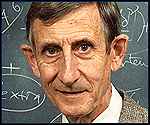
English-born theoretical physicist (became a U.S.
citizen in 1957), president of the Space Sciences Institute, and professor
emeritus at the Institute for Advanced Studies, Princeton, who has proposed
several novel ideas in the field of SETI and of
advanced space propulsion (see Project
Orion). Dyson has speculated how advanced civilizations might be able to
travel between stars (see interstellar
travel), continue to survive in the far future of the universe,
and capture the bulk of the radiative output of their host stars by immense
structures that have become known as Dyson
spheres. As one of the characters in Larry Niven's Ringworld
explains:
Dyson was one of the ancient natural philosophers,
pre-Belt, almost pre-atomic. He pointed out that civilization is limited by
the energy available to it. The way for the human race to use all the energy
within its reach, he said, is to build a spherical shell around the Sun and
trap every ray of sunlight. Dyson argued that the most
reasonable strategy in SETI is to assume that (as in the case of the human race)
extraterrestrial civilizations are not actively trying to communicate, and that
our best chance of finding them is to look for by-products of their
technological activity, such as "leaks", especially in the infrared
part of the spectrum. He has also suggested looking for the radiation "skid
marks" of alien starships as they decelerate from high speeds. An advocate of
the colonization of space, Dyson has acknowledged the source of much of his
inspiration:2
There's an aspect of things which I find amusing: the
flow back and forth between science and science fiction, which has been an
important part of my life. I started out reading science fiction and then
became a scientist, and that set the slant on my scientific work. I like to
make connections between life and cosmology and astronomy. Science fiction
raises all these interesting possibilities and has had some influence on
science in the last 25 years - not only in the area of SETI, but also in other
ways. Wells's
First Men in
the Moon and Stapledon's
Last and First Men and
Star
Maker, Dyson recalls as being especially influential. He was born in
Crowthorne, obtained a B.A. in mathematics from Cambridge University (1945) and
was a Fellow at Trinity College from 1946 to 1949. In 1947 he came to Cornell
University on a Commonwealth Fellowship and joined the faculty there as a
physics professor in 1951. He moved to Princeton two years later. Among his
non-technical and autobiographical works are Disturbing the
Universe (1979), Origins of Life 1986), and
Infinite in All Directions (1988). In another book,
Imagined Worlds, he writes of distant timescapes populated by our
descendants spread throughout the Galaxy in alliance with other intelligent
beings. They would be unrecognisable to us, he says. In 2000, he was awarded the
$1 million Templeton prize for progress in religion, the citation saying that
"his futurist views have consistently challenged mankind to reconcile technology
and social justice."
|