 |
Introduced geosynchronous orbits for satellites, noted science fiction writer.
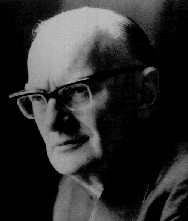
- Arthur C. Clarke was born in Minehead, England on December 16, 1917. Raised on his family's farm, he became interested in science when he was six, and built his first telescope at the age of thirteen. The following year his father died, and four years later, in 1936, Arthur dropped out of school due to financial difficulties and moved to London. There he joined the British Interplanetary Society (BIS) while working as a government auditor. He started to experiment with astronautic material in the BIS while writing the BIS Bulletin and science fiction stories.
- During World War II, as a Royal Air Force officer, Clarke was in charge of the first radar talk-down equipment, the Ground Controlled Approach, during its experimental trials. After the war, he returned to London and to the BIS, resuming his role as president from 1946 to 1947, and again from 1950 to 1953.
- In 1945, Clarke published the technical paper "Extra-terrestrial Relays," in which he expounded the principles of improving communication by placing satellites in geostationary orbits (meaning each satellite would stay directly above a fixed point on the Earth's equator). His idea did not become reality until 1963 with America's launch of the first satellite in a geostationary orbit, Syncom 2. Today, the geostationary orbit 26,000 miles above the Earth is named the Clarke Orbit by the International Astronomical Union, and the satellites in the orbit are called the Clarke Belt.
- One of the most prolific science fiction writers in history, Arthur C. Clarke was perhaps best known for writing the 1948 short story, "The Sentinel," which became the basis for the classic 1968 motion picture 2001: A Space Odyssey. His novels and stories often centered on space travel and other ways in which technology shapes the future. His works were noted for their scientific accuracy and their discussion of man's role in an ever more technological society.
- Arthur C. Clarke also helped popularize actual space exploration, helping to broadcast the Apollo 11, 12, and 15 missions with Walter Cronkite and Wally Schirra for CBS television. In 1982, he published a sequel to 2001, 2010: Odyssey Two and helped write the 1984 movie adaptation, 2010.
- In 1981, his TV series Arthur C. Clarke's Mysterious World debuted followed by Arthur C. Clarke's World of Strange Powers in 1984. On May 26, 2000, Clarke was formally presented with the "Award of Knight Bachelor" by the British government. Sir Arthur C. Clarke passed away on March 19, 2008 at his home in Sri Lanka. Asteroid 4923 Clarke is named in his honor.