 |
Helped to launch Sputnik and worked to establish cooperation in space between the USA and USSR.
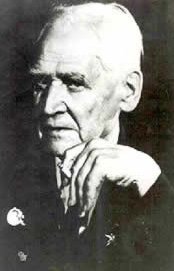
- Soviet scientist Anatoli Arkadyevich Blagonravov (1894-1975) was one of the key scientists responsible for the world's first man-made satellite, Sputnik (launched on October 4, 1957). Blagonravov graduated from the Mikhailovskoye Artillery School in 1916, the Higher Artillery School in 1924, and the Military Engineering Academy in 1929. After earning a Ph.D. in Engineering Science in 1938, Blagonravov was a professor of the Artillery Academy in Moscow from 1946 to 1950. Beginning in 1953, he directed the Institute of Machine Studies of the Academy of Sciences of the USSR. In this position he played a key role in the development of the Soviet space program, overseeing scientists such as Mikhail Tikhonravov and Sergei Korolev. In addition to his role in the launch of Sputnik, Anatoli Blagonravov was instrumental in the launching of the first living creature into orbit (the dog Laika, in 1957), and the first manned space mission (Yuri Gagarin, in 1961). From 1962 to 1965, Dr. Blagonravov headed a Soviet delegation for talks with American representatives on agreement to collaborate in the study and use of space for peaceful purposes. NASA's Dr. Hugh L. Dryden was his American counterpart in these meetings.
- During the Apollo 11 mission Blagonravov, a Lieutenant General in the Soviet Army, said that the people of the world were hoping for the safe return of the "courageous astronauts." In December 1969, NASA's Dr. Thomas Paine sent the Soviet Academy of Sciences a copy of the agency's post-Apollo plans and suggested exploration of cooperative programs. In April 1970, Dr. Paine, in an informal meeting with Dr. Blagonravov in New York, proposed that the two nations cooperate on astronaut safety, including compatible docking equipment on space stations and shuttles to permit rescue operations in space emergencies.
- Further discussions led to an October 1970 agreement on joint efforts to design compatible docking arrangements, which would allow for transfer of people or supplies between spacecraft of different nations. By December 1971, three working groups were set up to tackle the problem and agreements on further details were reached in Houston, Texas, and in Moscow. A team led by NASA Deputy Administrator George M. Low met with a Soviet delegation in Moscow from April 4 to 6, 1972 to draw up a plan for docking a U.S. Apollo spacecraft with a Russian Soyuz in earth orbit in 1975. Dr. Blagonravov played a major role in these efforts, which culminated in the Apollo-Soyuz Test Project (ASTP) mission in July 1975. Although this was five months after his death, he died knowing the project would in fact occur. The ASTP demonstrated the benefits of international cooperation in space, and laid the foundation for the International Space Station two decades later, bringing Anatoli Blagonravov's dream of international cooperation in space to reality.