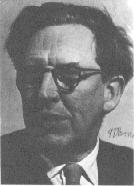
Irish physicist who carried out important
research into the chemical origin of life and speculated on what general
principles might apply to all forms of life in the Universe.1 He also
inquired into the future of mankind and the colonization of
space. Bernal graduated from Emmanuel College, Cambridge, and began his
research career in crystallography under William Bragg at the Davy-Faraday
Laboratory, in London, befre returning to Cambridge. In 1937, he was appointed
to the Chair of Physics at Birkbeck College, London where his studies in
crystallography led him to examine increasingly complex biological materials
and, eventually, the processes leading to the origin of life. In a 1947 lecture,
"The Physical Basis of Life," he suggested that clays may have played a role in
concentrating organic molecules (see clays, role in
prebiotic evolution) and pondered on the nature of life in a cosmic context:
Terrestrial limitations obviously beg the question of whether
there is any more generalized activity that we can call life.... Whether there
are some general characteristics which would apply not only to life on this
planet with its very special set of physical conditions, but to life of any
kind, is an interesting, but so far purely theoretical question. In
a 1952 lecture to the British
Interplanetary Society (chaired at the time by Arthur C. Clarke) he further
helped bring the possibility of extraterrestrial life into the province of
mainstream biology by arguing that "the biology of the future would not be
confined to our own planet, but would take on the character of cosmobiology."
Following the discovery of organic substances in the Orgeuil
meteorite, Bernal suggested2 the material may have been due to
contamination on Earth; otherwise, it must have formed inorganically in space or
as the result of living things on the parent body from which the meteorite came.
An inorganic origin, as a result of processes in the early solar system, said
Bernal, could mean that meteorites provided the raw materials for the first
synthesis of life on Earth (see cosmic
collisions, biological effects). As long ago as 1929, in his remarkably
perceptive book The World, the Flesh and the Devil,3 Bernal
discussed the possibility of colonies in space (see Bernal
Sphere).
|