Manned Flight n°: 196 |
Earth orbit Flight n°: 193 |
USA manned Flight n°: 113 |
Launch, orbit & landing data:
| Designation | 24719 / 97004A |
| Launch date - time | 11 Feb 1997 - 08:55:17 UT |
| Launch site | KSC, LC39A |
| Launch vehicle |
Space Shuttle |
| Orbiter | Discovery #22 (OV-103) |
| Primary payload | External Airlock |
| Mass (kg) | |
| Flight Crew | Bowersox, Horowitz, Tanner, Hawley
Harbaugh, Lee, Smith |
| Earth orbit on : |
| - Perigee / Apogee | 579 km |
| - Inclination | 28.45° |
| - Period | min |
| Landing date - time | 21 Feb 1997 - 08:32:26 UT |
| Landing location | Ksc, Runway 15 |
| Flight Duration (d:hr:min) | 9d 23h 37m |
| Nbr orbits | 149 |
|
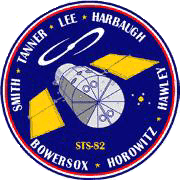
|
Crew
| Nr. |
Surname |
Given name |
Job |
Duration |
| 1 |
Bowersox |
Kenneth Dwane |
CDR |
9d 23h 37m |
| 2 |
Horowitz |
Scott Jay "Doc" |
PLT |
9d 23h 37m |
| 3 |
Lee |
Mark Charles |
MSP |
9d 23h 37m |
| 4 |
Hawley |
Steven Alan |
MSP |
9d 23h 37m |
| 5 |
Harbaugh |
Gregory Jordan |
MSP |
9d 23h 37m |
| 6 |
Smith |
Steven Lee |
MSP |
9d 23h 37m |
| 7 |
Tanner |
Joseph Richard |
MSP |
9d 23h 37m |
Mission details:
Launch from Cape Canaveral (KSC); landing on Cape
Canaveral (KSC); second Hubble-Servicing-Mission; satellite was captured
with the RMS; several EVA`s to upgrade the scientific capabilities of the
Hubble Space Telescope (HST); first EVA by Smith and Lee on 14.02.1997 (6h
42m), replaced the Goddard High Resolution Spectograph (GHRS) by the Space
Telescope Imaging Spectograph (STIS) and the Faint Object Spectrograph
(FOS) by the Near Infrared Camera and Multi-Object Spectrometer (NICMOS);
second EVA by Tanner and Harbaugh on 15.02.1997 (7h 27m) in which the Fine
Guidance Sensor (FGS) and one Engineering / Science Tape Recorder (ESTR)
were exchanged and the Optical Control Eletronics Enhancement Kit was
installed; in a third EVA on 16.02.1997 (7h 11m) astronauts Smith and Lee
exchanged one Data Interface Unit (DIU) and replaced a second ESTR by a
Solid State Recorder (SSR); at last they removed an older Reaction Wheel
Assembly (RWA) and installed a new one; fourth and final planned EVA by
Tanner and Harbaugh on 17.02.1997 (6h 34m); they exchanged one of the
Solar Array Drive Electronics (SADE) and installed some covers on the
magnometers; after that they started to repair the thermal isolation on
the HST - this was not planned, but the isolation was rather damaged; in a
final not planned EVA on 18.02.1997 (5h 17m) astronauts Smith and Lee
completed repairing work on the isolation; after the successful work the
Hubble Space Telescope was again deployed and worked fine.
11 February 1997
08:55 GMT. Duration: 9.98 days. Agency: NASA-JSC.Payload: Discovery F22 / SAC. Perigee: 584 km. Apogee: 618 km. Inclination: 28.5 deg. Period: 96.7 min.
After a spectacular night launch, the Shuttle completed its rendezvous with Hubble Space Telescope on February 13. Over the next four days five spacewalks were undertaken to renovate Hubble.
The Hubble Space Telescope was released back into orbit at 06:41 GMT on February 19. Discovery landed on Runway 15 at Kennedy Space Center at 08:32 GMT on February 21.
After the OMS 2 burn Discovery was in a 350 x 579 km x 28.5 deg orbit; later on February 11 perigee was raised to 480 km and on February 12 it was in a 576 x 584 km orbit. The Hubble Space Telescope was in a 589 x 598 km x 28.5 deg orbit. The Shuttle completed its rendezvous with Hubble on February 13. Steve Hawley used the RMS arm to grapple HST at 08:34 GMT and by shortly after 09:00 GMT the telescope was docked to the FSS (Flight Support Structure) in the aft part of the cargo bay. Over the next four days five spacewalks were undertaken to renovate Hubble.
On February 14 astronauts Mark Lee and Steven Smith carried out spacewalk EVA-1 to install the STIS and NICMOS science instruments. The spacewalkers discovered potentially serious rips in Hubble's insulation, caused by degradation over the seven years the material has been in orbit. An orbital debris puncture in an antenna was also noticed. EVA-2, by Greg Harbaugh and Joe Tanner, replaced the Fine Guidance Sensor in a 7h 26m spacewalk. EVA-3, by Lee and Smith, made a 7h 11m walk to install a new computer and data recorder. EVA-4 was 6h 34m and saw installation of new electronics and covers on the magnetometer sensors, plus initial repairs to the insulation. EVA-5 involved more insulation repairs; the astronauts then spent some time in the airlock awaiting word on whether an extra gyro replacement would be needed, before finally cleaning up the payload bay and repressurizing after a 5h 17m walk. No sixth spacewalk was needed; a suspect Reaction Wheel Assembly has tested out and did not need to be replaced.
Developmental Test Objectives / Detailed Supplementary Objectives
DTO 255: Wraparound DAP Flight Test Verification
DTO 312: External Tank TPS Performance
DTO 684: Radiation Measurements in Shuttle Crew Compartment
DTO 700-9A Orbiter Evaluation of TDRS Acquisition in De-spreader
DTO 805: Crosswind Landing Performance
DTO 840: Hand-Held Lidar Procedures
DSO 331: Integration of the Space Shuttle Launch and Entry Suit
DSO 487: Immunological Assessment of Crewmembers
DSO 493: Monitoring Latent Virus Reactivation and Shedding in Astronaut
PAYLOAD AND VEHICLE WEIGHTS: Orbiter (Discovery) empty and 3 SSME's: 82,952 kg; Shuttle System at SRB Ignition: 2,047,270 kg; Orbiter Weight at Landing with Cargo: 96,762 kg; Flight Support System: 2,033 kg; Orbital Replacement Unit Carrier: 3,165 kg; Second Axial Carrier: 2,392 kg; Hubble Space Telescope (while berthed to Discovery) 11,140 kg.
|
Ref.: #7, #8, #16 - update: 16.03.05
|
Home |