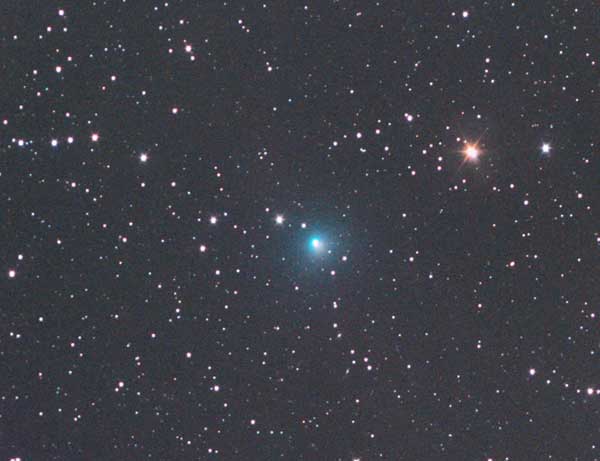
9P/ Tempel 1 Comet

Int


Astronomical specifications:

Discovery April 3, 1867
Orbital characteristics:
Distance from Sun  km
Perihelion  (106 km)
Aphelion  (106 km)
Inclination  deg
Eccentricity 
Orbital periode rond Sun 5.68 years
Main orbital speed  km/s
Inclination to Sun equator  deg
Physical characteristics:
Dimensions  km
Radius  km
Surface area  km²
Volume  106 km³
Mass  1024 kg
Density  g/cm³
Equatorial surface gravity  m/s²
Escape velocity  km/s
Rotation period  days
Surface temperature  K
Axial tilt  deg
Atmospheric composition 

This image was obtained on 2005 May 1.87 UT with the 8-inch Celestron Schmidt camera and a SXV H9 CCD camera. The image was a combination of 8 separate images and had a total exposure time of 28 minutes. Credit: 2005 by Michael Jäger (Austria)


Discovery:

Ernst Wilhelm Liebrecht Tempel (Marseille, France) discovered this faint, diffuse comet in Libra on 1867 April 3.90. Later calculations revealed it was then situated 0.71 AU from Earth and 1.64 AU from the sun. Tempel noted the comet had an apparent diameter of 4-5 arc minutes and noted "several little stars" pulsating in the middle. The comet was only slightly condensed.

Historical Highlights:

External links:


Tempel 1 missions:

Name Launch
Date
Launch rocket Weight
(kg)
Mission
Stardust (USA) 07-Feb-99 Delta II 380 kg Comet flyby and sample return. Encountered Comet Wild 2 on 2-Jan-04; sample cannister successfully returned to Earth 15-Jan-06. Flyby of comet 9P/Tempel-1 at 04:39 UTC on Feb 15, 2011. Stardust is now in a 0.971 x 1.728 AU x 8.5 deg solar orbit and is currently in the paramartian region.
Deep Impact (USA) 12-Jan-05 Delta II 1020 kg Flyby spacecraft and impactor to study interior of Comet Tempel 1; impact successfully occured 4-Jul-05. Flyby spacecraft mass 650 kg; impactor 370 kg.


Ref.: #7(JR706), #130 - update: 24.01.15 Home