DSCOVR

US

Spacecraft nº:

US spacecraft nº:

DSCOVR= Deep Space Climate Observatory - Also called: Triana and GoreSat

Launch data:

Designation 40390 / 15007A
Launch date 11 Feb 2015 - 23:03 UT
Launch site CC, SLC-40
Launch vehicle  Falcon-9 v1.1
Mission Earth observing, solar science
L1 orbit:
Perigee / Apogee 187 x 1371156 km
Eccentricity 
Inclination  33.1°
Period  min
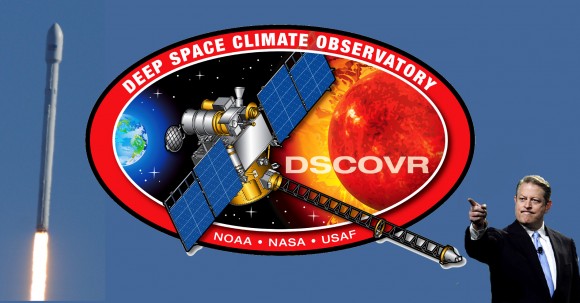
DSCOVR patch

The Deep Space Climate Observatory (DSCOVR) mission now stands prepared for launch. (Credit: NASA, NOAA,SpaceX, Getty Images)


Spacecraft data:

Prime manufacturer Swales (bus)
Platform SMEX-Lite Bus
Operator NASA, NOAA
Mass at launch  570 kg
Dry Mass 425 kg with an additional 145 kg of hydrazine propellant
Basic shape  
Dimension (m) 
Equipment Scripps-EPIC, Scripps-NISTAR, Plasma-Mag
Solar array 2 deployable solar arrays
Stabilization  3-axis
Propulsion 10 × hydrazine thrusters
DC power  
Design lifetime  
DSCOVR in cleanroom

DSCOVR in cleanroom. (Credits: NASA)


DSCOVR

DSCOVR in the final stages of integration prior to shipment to the Cape. Two perspectives, one with engineers in a clean room revealing the relative size. (Photo Credits: NASA/GSFC))


Description history:


DSCOVR’s instrument payload, low-cost (~$250M) and scientific objectives stand in contrast to the 12 years of political limbo that the mission withstood. (Image Credit: NASA)

DSCOVR position

The DSCOVR spacecraft will be delivered to the Sun-Earth L1 point, 1.5 million km from the Earth, directly in front of the Sun. A Halo (Lissajous) orbit will stabilize the craft’s position around the L1 point while keeping it outside the radio noise emanating from the Sun. (Illustratin Credit: NASA)


Mission details:

External links:


Ref.: #6, #7(JR709-710), #12, #110, #129, #228, #242 - update: 23.08.15 Home