INTEGRAL

ESA


Spacecraft nº:

ESA spacecraft nº: 50

International Gamma Ray Astrophysics Laboratory

Launch data:

Designation27540 / 02048A
Launch date17 Oct 2002 - 04:41 UT
Launch site B, LC200/39
Launch vehicle  Proton-K / DM-2 (17S40) (#297)
MissionGovernment: Space Physics (gamma-ray astronomy)
Deep Highly Eccentric Earth orbit:
Perigee / Apogee 2284 x 152812 km
Eccentricity 8,97E-01
Inclination 52.1 deg
Period 4032.86 min

An artist's impression of the INTEGRAL spacecraft. Credit: ESA


The launch is provided against 25% of the observation time to Russian scientists.

Specifications

Prime contractorAlenia Aerospazio (and 28 subcontractors)
Platform Same as XMM
Operator European Space Operations Centre (ESOC)/NASA/Russia
Mass at launch 4100 kg
Dry Mass 3414 kg
Payload mass ~2000 kg
Dimension  5 m height x 3.7 m diameter
Solar array  
Stabilization  
DC power 2000 W
Design lifetime 2 yrs - still active

Astronomical satellite for observing the gamma-ray sky.
It has turned out that the satellite is affected by space weather. The constant rain of tiny particles can temporarily blind detectors designed to register gamma radiation.

Instruments

Spectrometer SPI (Spectrometer on Integral): sources in 20 keV - 8 MeV, 0.7m coded mask telescope
Imager IBIS (Imager on Board the Integral Satellite): sources in 20 keV - 10 MeV, 1.1m square coded mask telescope
X-Ray Monitor JEM-X, two 0.5m coded mask telescopes covering the 3 - 35 keV range
Optical Monitoring Camera OMC, 0.05m aperture optical telescope
Integral Science Data Centre Isdc

Astrophilately covers:

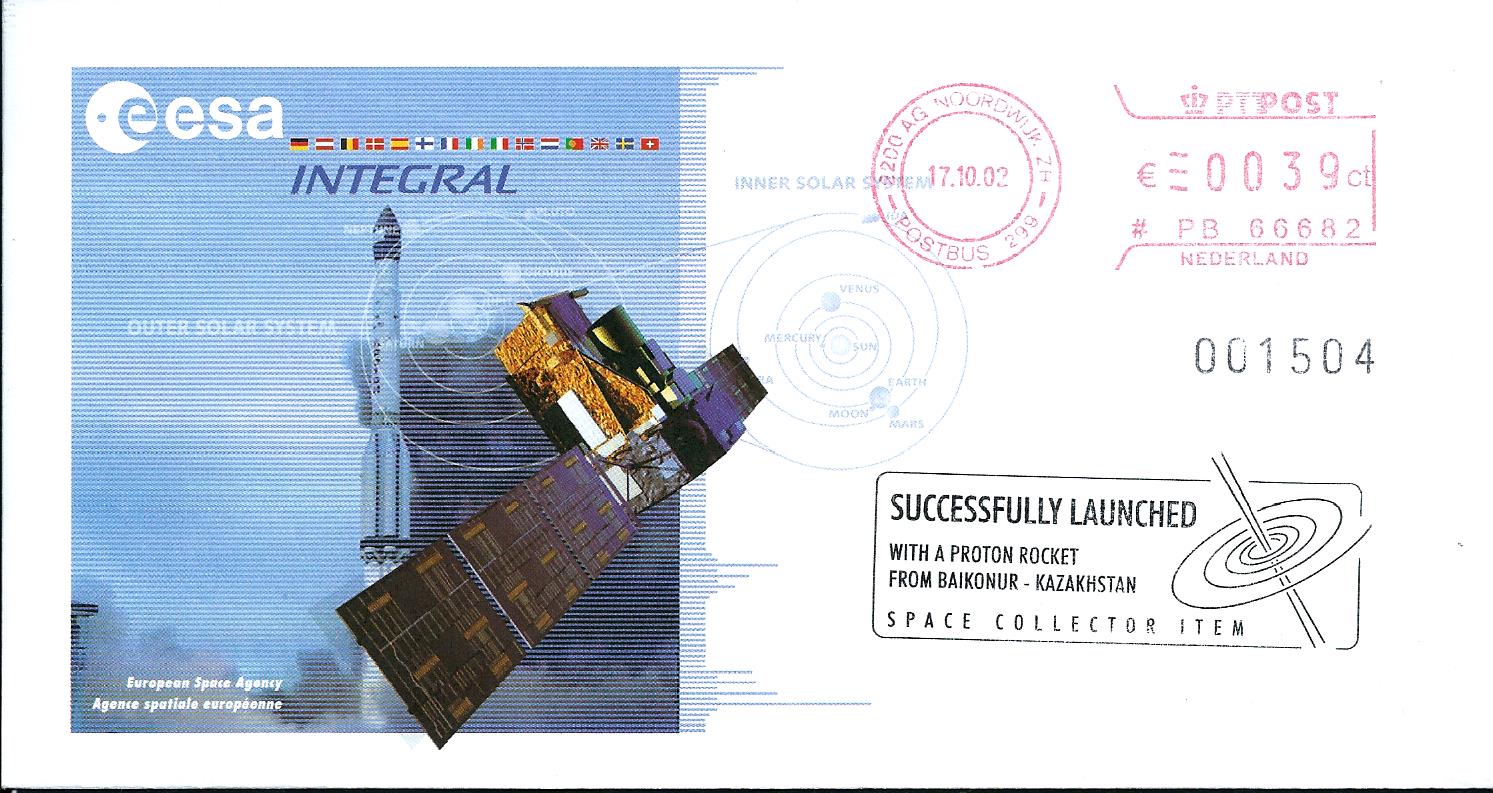
Integral)

Launch cancel Noordwijk (centre ESA)


Ref.: #6r, #7, #15, #226 - update: 25.07.19 Home