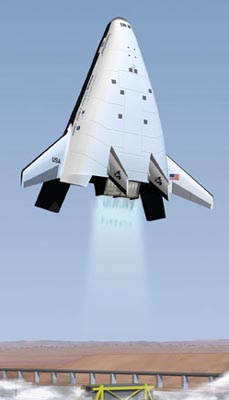
The X-33 was a half-scale prototype of the proposed VentureStar® reusable launch vehicle (RLV). The X-33 was
designed and built as part of a “cooperative agreement” between NASA and an industry team led by Lockheed
Martin that included Boeing (Rocketdyne), B.F.Goodrich(formerly Rohr Industries), Honeywell (formerly
AlliedSignal), and Sverdrup. The X-33 was a suborbital demonstrator and was never intended to reach orbit.
Initially the vehicle was intended to reach velocities of Mach 15, although this was later reduced to Mach 12.
The X-33 was designed to demonstrate unique aerospike engines, composite liquid hydrogen tanks, a metallic thermal
protection system, and an austere launch site environment. The development program ran into problems almost
immediately, and the failure of the composite liquid hydrogen tanks during full-scale testing led to massive cost overruns
during late 2000 and early 2001. As a result, NASA cancelled further funding for the X-33 in March 2001 after
the vehicle was about 75 percent complete. This left Lockheed, who had already invested over $200 million of company
funds in the project, free to complete and fly the X-33 alone, but the company elected not to do so.
Technical Data:
Manufacturer:
Lockheed Martin Corporation
Operator:
NASA, Lockheed Martin
Length :
m
Heigh:
m
Span:
m
Weight (kg):
-
Rocket motor:
Thrust:
-
Flights
None, cancelled
X-33
Notes:
Stage Number: 1: 1 x X-33 Gross Mass: 123,800 kg. Empty Mass: 28,600 kg. Thrust (vac): 233,000 kgf. Isp: 439 sec. Burn time: 886 sec. Isp(sl): 339 sec.