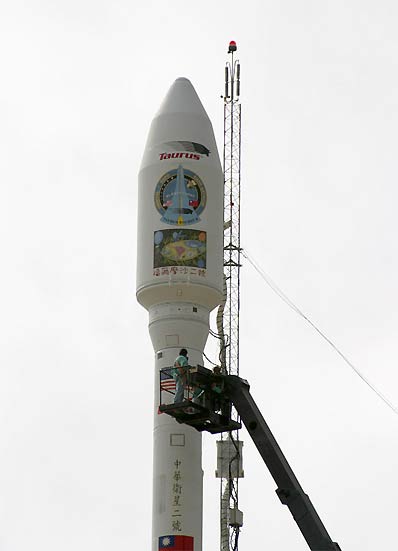
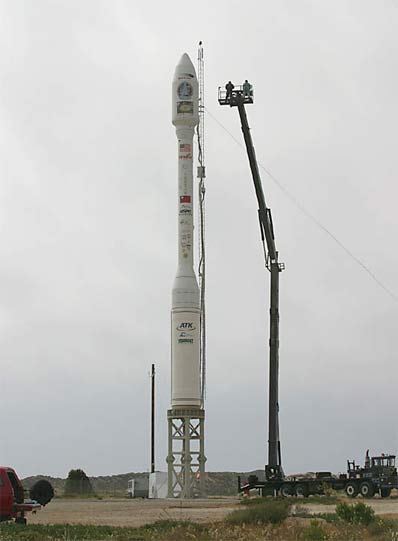
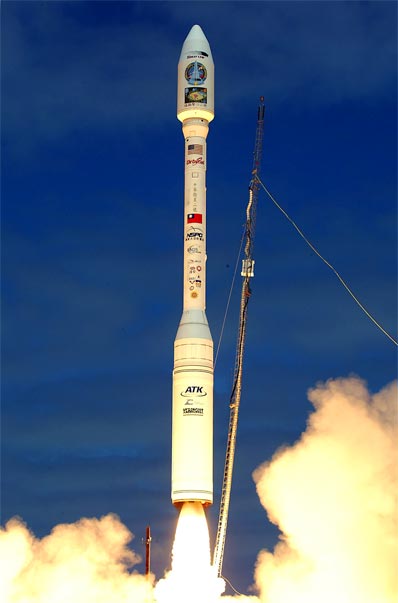
Workers make final closeouts to the Taurus vehicle.
The Taurus rocket offers an affordable, reliable means of launching
small satellites into low-Earth orbit. Developed under the sponsorship
of the Defense Advanced Research Projects Agency (DARPA), Taurus was designed
for easy transportability and rapid set-up and launch. Since its debut
flight in 1994, Taurus has conducted five of six successful missions launching
11 satellites for commercial, civil, military, and international customers.
Taurus is a ground-based variant of the air-launched Pegasus rocket. The
four-stage, inertially guided, all solid propellant vehicle can deploy
1,350-kilogram (3,500-pound) satellites into low-Earth orbit. Two fairing
sizes offer flexibility in designing a particular mission, and with the
addition of a structural adapter, either can accommodate multiple payloads,
resulting in lower launch costs for smaller satellites "sharing" a mission.
A cornerstone of the Taurus program is a simplified integration and test
capability that includes horizontal integration of the rocket's upper
stages and offline encapsulation of the payload within the fairing. The
upper stages and the encapsulated cargo are delivered to the launch site,
where they are mated. The whole assembly is then stacked on the first
stage using a mobile crane.
The Taurus launch system includes a complete set of ground support equipment
to ensure the ability to operate from austere sites. Thus far, Taurus
has launched from the U.S. Government's Western range at Vandenberg Air
Force Base (VAFB) in California. Taurus is also approved for launch from
Cape Canaveral Air Station (CCAS) in Florida, Wallops Flight Facility
(WFF) in Virginia, and Kodiak Launch Complex, Alaska.