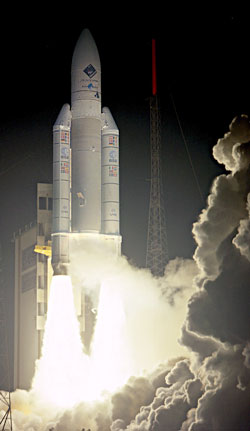
The Ariane 5 rocket fired up at 0717:44 GMT (2:17:44 a.m. EST) on Mar 02, 2004, exactly when the booster could place the
probe on the first leg of its ten-year course to comet Churyumov-Gerasimenko.
Minus-1 minute. A fast-paced series of events leading to launch will begin at Minus-37 seconds when the automated ignition
sequence is started. The water suppression system at the launch pad will start at Minus-30 seconds. At Minus-22 seconds, overall
control will be given to the onboard computer. The Vulcain main engine will be readied for ignition with hydrogen chilldown starting
at Minus-18 seconds. The residual hydrogen burn flares will fire beneath the Vulcain engine at Minus-6 seconds to burn away any free
hydrogen gas. At Minus-3 seconds, onboard systems take over and the two inertial guidance systems go to flight mode. Vulcain main
engine ignition occurs at Minus-0 seconds with checkout between Plus+4 and 7 seconds. If there are no problems found, the solid
rocket boosters are ignited at Plus+7.0 seconds for liftoff at Plus+7.3 seconds. Minus-40 seconds. The vehicle is now switching to internal power. 0717:44 GMT (2:17:44 a.m. EST) Liftoff Plus+35 seconds. The launch vehicle has performed its pitch and roll maneuvers for the flight downrange, heading eastward
from the South American coast. Plus+2 minutes, 30 seconds. The solid rocket boosters have been jettisoned from the Ariane 5 rocket's core stage. The liquid-fueled
Vulcain 1 main engine continues to fire to propel the vehicle and Rosetta to space. Plus+3 minutes, 15 seconds. The bullet-shaped protective nose cone enclosing Rosetta has separated from the Ariane 5. Two pyrotechnic
devices -- one horizontal and the other vertical -- is used to separate the fairing's two halves. The vertical device imparts enough
impulse to the separated fairings to clear them away laterally.
Altitude is 108 km, velocity is 2.3 km/sec. Plus+10 minutes, 30 seconds. Engine cutoff and stage separation! The Ariane 5 rocket's Main Cryogenic Stage's Vulcain engine shut down
following its firing and the spent stage has been separated from the upper stage with Rosetta.
The Main Cryogenic Stage is suborbital, meaning it will naturally fall back to Earth before even completing a single orbit. It will
burn up over the Pacific Ocean, breaking up at an altitude of between 80 and 60 km under the loads due to atmospheric re-entry. Plus+1 hour, 56 minutes, 45 seconds. Ignition! The upper stage of Ariane 5, called the Storable Propellant Stage, has fired to life
for its burn to to send the 6,700-pound craft out of Earth's grasp and into solar orbit. Plus+2 hours, 12 minutes. The rocket and Rosetta have zoomed past their close approach to Earth. They are now powering away from the
planet. Altitude is 773 km, velocity is 10.2 km/sec. Plus+2 hours, 15 minutes. SPACECRAFT SEPARATION! The European Space Agency's Rosetta spacecraft has been released from the Ariane 5 rocket
following today's launch on a decade-long mission to explore comet Churyumov-Gerasimenko.