Description:
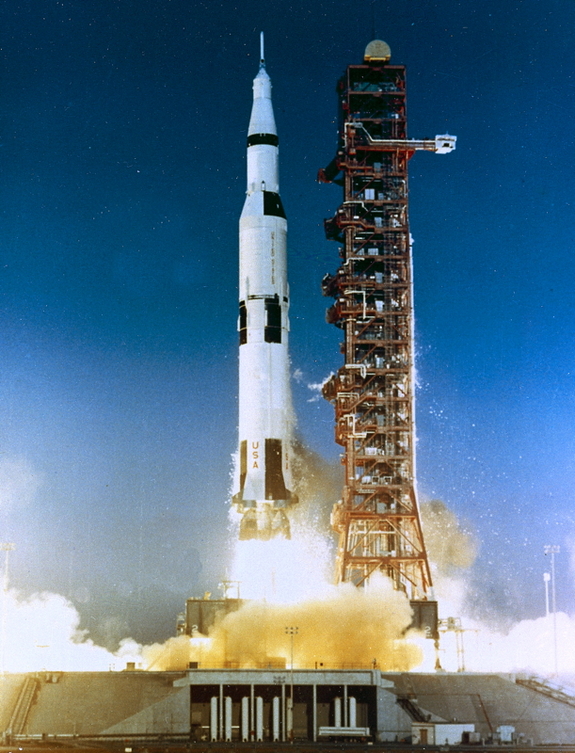
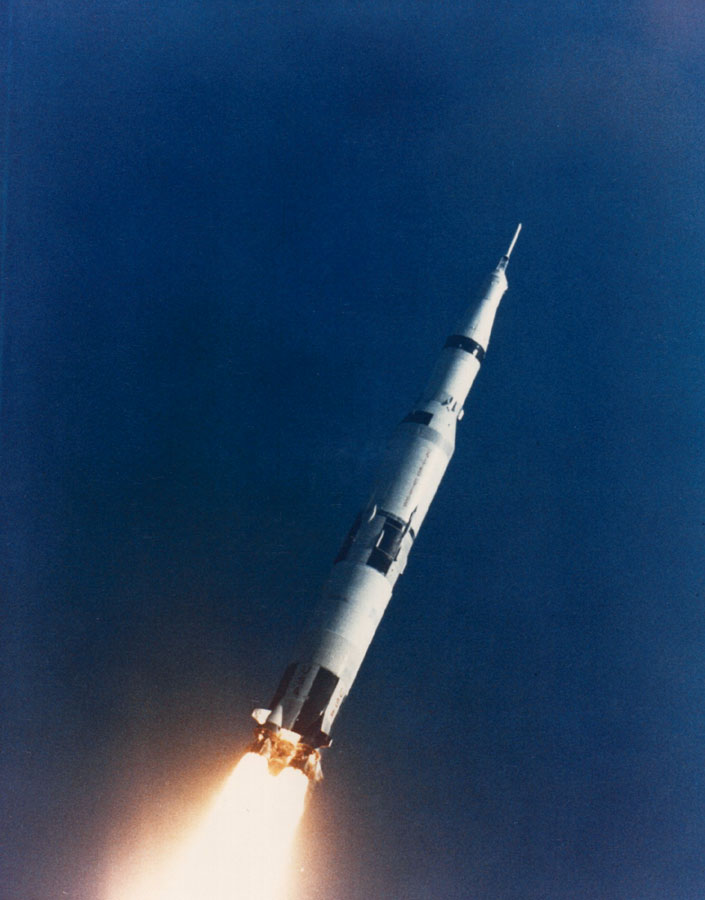
- NASA developed the Saturn V rocket to meet the challenge. Taller than a 36-story building (363 feet / 111 meters), it was the
largest, most powerful rocket ever launched. Powered by five engines in each of its first two stages, the rocket produced 7.5
million pounds of thrust at liftoff.
[Infographic: Apollo 11 Moon Rocket's F-1 Engines Explained
- The Saturn V had three expendable stages. The first two stages each had five engines that burned either a mix of kerosene
and liquid oxygen, or liquid hydrogen and liquid oxygen. Each stage lifted the rocket until its fuel was expended. The first stage
lifted the rocket about 42 miles (68 kilometers). The second stage carried it almost into orbit. The third stage placed the Apollo
spacecraft into orbit and pushed it toward the moon. The first two stages fell into the ocean after separation. The third stage
either stayed in space or hit the moon.
- Fifteen Saturn V rockets were built. Two were tested without a crew. The first Saturn V launched with a crew was Apollo 8. That
mission orbited the moon in December 1968. Two more missions tested the lunar landing vehicle. Then, in July 1969 a Saturn V
launched the crew of Apollo 11 to the first manned landing on the moon. A Saturn V rocket carried six more missions into space. A
two-stage Saturn V also lifted Skylab into orbit.
- Launch vehicle: Saturn V
- Payload: Apollo 6
- Launch date: 1968 Apr 4
- Launch site: KSC LC39A/LUT2
- Launch vehicle ID: SA-502
Ref: #7a, #11 - update: 25.12.13