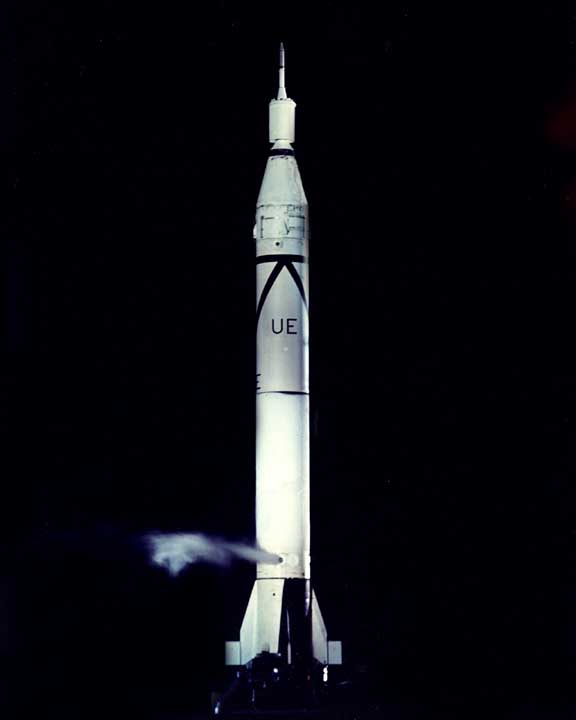
The rocket that launched America′s first satellite has several names including; Juno I, Jupiter C and Explorer I, which will
be explained in describing its history. In 1951 Werner Von Braun and his team started development of the Redstone missile as the first
Intermediate Range Ballistic Missile (IRBM). The Redstone had a range of about 200 miles and used liquid oxygen and alcohol as fuel.
The rocket was controlled by four vanes at the base rocket underneath the engine bell.
In June 1954 Von Braun proposed Project Orbiter in which the Redstone would be modified to launch a satellite. The proposal was
rejected since it was premature. The following year the United States announced that it would orbit a satellite as part of the International
Geophysical Year (IGY) which ran from July 1, 1957 to December 31, 1958. The government, however, decided to develop the Vanguard which
was being developed by the Naval Research Laboratory, rather than the Army’s Redstone. One of the reasons for choosing Vanguard was
that it was a new rocket that had not been developed as a weapons system, as was the case with Redstone.
Von Braun continued development of the Redstone as a launcher to test the re-entry of nosecones on high speed flights. The missile
was lengthened by eight feet and used Hydyne as the propellant rather than alcohol. Hydyne consists of 60% unsymetrical dimetylhyrdazine
(UDMH) and 40% diethyltriamine. This variant of the Redstone is known as the Jupiter C.
The world was shocked by the launch of Sputnik I on October 4, 1957 by the Soviet Union. One month later, the Soviets launched
Sputnik II into orbit carrying the dog, Laika, the first living being in space. The Soviet accomplishment was even greater since
Sputnik II weighed almost half a ton. Five days after the launch of Sputnik II, the government instructed Von Braun to prepare one of
the Jupiter C rockets to launch the Explorer I satellite within 90 days.
The American government still hoped that the Vanguard project would launch America’s first satellite. The Vanguard satellite was
the size of a grapefruit with a diameter of only 6.4 inches and weighed only 3.5 pounds. Unfortunately, on December 6, 1957 in full
view of the world′s cameras, Vanguard I exploded on the launch pad.
The Jupiter C was further modified to launch Explorer I as America′s first satellite. Three more stages were placed atop the Jupiter
C in order to reach orbital velocity. The Juno I launcher was 71.25 feet tall with a diameter of 5.8 feet. The entire rocket weighed
just 64,000 pounds. The single Rocketdyne A-7 engine in the first stage developed 83,000 pounds of thrust.
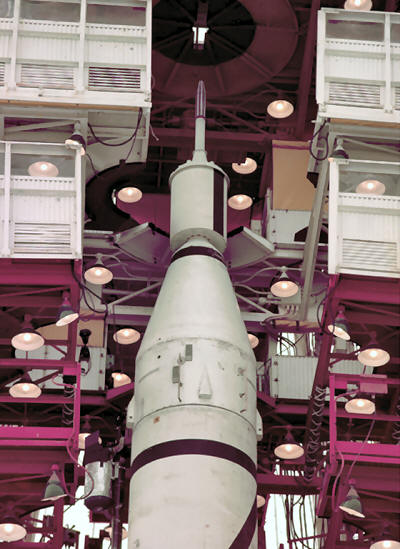
The top stages of Juno I and the Explorer 1 satellite
The second stage consisted of 11 Sergeant solid fueled rockets in a circle. The second stage had a combined thrust of 16,500
pounds. The third stage was three more Sergeants that were within the circle of Sergeants of the second stage. In the center was the
fourth stage, a single Sergeant that was attached directly to the Explorer I satellite. These four Sergeants each provided thrust of
1800 pounds, which was sufficient to propel Explorer I into orbit. The configuration of the Jupiter C and the three upper stages of
Sergeant rockets was named the Juno I launcher. The Juno I was launched six times of which four successfully orbited satellites.
Just 84 days after being given the go-ahead, Juno I launched America’s first satellite into orbit on January 31, 1958. Explorer I
was small in comparison to the Russian satellites. It weighed only 30.8 pounds and had a length of 6.66 feet, including the Sergeant
motor, with a diameter of only 6 inches. The satellite was designed by the Jet Propulsion Laboratory under Dr. William Pickering. The
instrumentation section included a cosmic ray detector, temperature gauges and a micrometer detector. Juno I launched the Explorer I
satellite into a 225 to 1,594 mile high orbit and it did not re-enter for 12 years until 1970.
The Juno 1 was diminutive in comparison to the Soviet R-7 booster which launched Sputnik. The R-7 was originally developed as an
ICBM and as the Sputnik launcher generated 876,000 pounds of thrust, which was ten times more than Juno I. The Sputnik launcher stood
111 feet tall and weighed more that 675,000 pounds. The R-7 became the mainstay of the Russian space program and still is used nearly
fifty years later to launch most satellites, as well as the Progress and Soyuz spacecraft.