Flight: ISS-1R.
Launch, orbit & landing data:
| Designation | 26400 / 00037A |
| Launch date - time | 12 Jul 2000 - 04:56:36 UT |
| Launch site | Baikonur, LC81/23 |
| Launch vehicle |
Proton-K (nº398-01) |
| OKB name - S/Nº | 77KSM nº 128-01 |
| Mass (kg) | 19 050 kg (20295 kg?) |
| Docking date - time | 26 Jul 2000 - 00:45 UT |
| Target spacecraft/port | Zarya rear port |
| Orbital parameters on Jul 26, 2000 (.14): |
| - Perigee / Apogee | 351 x 368 km |
| - Inclination | 51.58° |
| - Period | 91.73 min |
| Descent date - time | Still in orbit - ISS |
| Flight Duration (d:hr:min) | |
| Nbr orbits | |
|

Zvezda service module with a Progress docked on the left and the Zarya FGB docked on the right. (NASA)
|
Spacecraft specifications:
| Prime manufactor | |
| Platform | |
| Operator | |
| Mass at launch | 19710 kg (20295 kg?) |
| Dry Mass | kg |
| Basic shape | Stepped cyl + sphere |
| Dimension (m) | 13.11 long, 4.15 max dia |
| Equipment | |
| Solar array | 29.73 span |
| Volume of airtight sections, cubic meters: |
89 |
| Area of photovoltaic cells, meters squared: |
76 |
| Average power of power supply, KVT/SUT: |
9.8 |
| Fuel mass, kg: |
860 |
| Duration of functioning in orbit, years: |
15 |
| Stabilization | |
| Propulsion | |
| Maximum crew the module can support: |
to 6 |
Summary:
Third ISS module to be launched. - Russian module "Zvezda" ("Star"). Docked to aft port of module
"Zarya"
Mission details:
- ISS Zvezda is a Russian service module for the International
Space Station. Its name is from the Russian Звезда, meaning 'star'. The eighth civilian Salyut-class space station 17KSM No. 128-1, was successfully launched on Jul 12 at 0456 UTC. The three stage Krunichev Proton-K rocket reached orbit at 0505 UTC. This
was the fifth Proton launch in a month. Zvezda's initial orbit was
179 x 332 km x 51.6 deg. On Jul 14 the orbit was raised to 288 x 357 km.
ISS is in a 365 x 372 km orbit.
- Docking with the Zarya/Unity on July 26 at 00:45 UT. The basic structural frame was initially built in the mid 1980's and
designed to be the core of the Mir 2 space station, which the ISS replaced, and,
in fact, was labeled as "Mir-2" for quite some time in the factory. Zvezda is outwardly almost identical to the Mir core module launched in 1986, and the main structure is similar to all the civilian DOS orbital
stations launched since 1971 built by the Krunichev company and
developed and operated by Energiya.
- Due to Russian financial problems, Zvezda was launched with no backup and no
insurance. Due to this risk, NASA had constructed an Interim Control
Module in case it was delayed significantly or destroyed on launch. However,
without the Service Module, it would be several more flights before the ISS
would be able to support a permanent crew.
- Zvezda is the structural and functional center of the Russian portion of the
ISS -- the Russian
Orbital Segment and the early core of the station. Zvezda provided early
living quarters, a life support system, a communication system, electrical power
distribution, a data processing system, a flight control system, and a
propulsion system. These quarters and systems are to be supplemented or replaced
by future ISS components.
Zvezda consists of a cylindrical "Work Compartment" where the crews work and
live, a cylindrical "Transfer Chamber" which has one docking port, an
unpressurised "Assembly Compartment" surrounding the Transfer Chamber, and a
spherical "Transfer Compartment" with three docking ports.
The Transfer Compartment attaches currently to the Zarya module and has docking ports
intended for the Science Power
Platform and the Universal Docking
Module. However, currently the lower port contains the Russian Docking Compartment
and the other is empty. It can be used as an airlock, however, if the hatch
fails, it will be impossible to travel to the rest of the station, so that
capability has never been used.
The Assembly compartment holds external equipment such as thrusters,
antennas, and propellant tanks.
The Transfer Chamber is equipped with automatic docking equipment and is used
to service Soyuz and Progress spacecraft.
Zvezda contains sleeping quarters for two astronauts, A NASA-provided
treadmill and a bicycle for exercise, toilet and other hygiene facilities, a
galley with a refrigerator and freezer. It contains the primary Russian
computers for guidance and navigation. It has a total of 14 windows -- three
9-inch diameter windows in the forward Transfer Compartment, a 16-inch in the
Working Compartment, a window in each crew compartment, and several more. It
also contains the Elektron system that uses condensed humidity and waste water,
electrolyzes it, and provides hydrogen and oxygen. The hydrogen is exhausted
into space and the oxygen is used for breathing air. The condensed water and the
waste water can be used for drinking in an emergency, but ordinarily other fresh
water from Earth is used. There are 16 small thrusters and two large thrusters
for propulsion and eight batteries for storing power.
The Elektron system has required significant maintenance work, having failed
several times and requiring the astronauts to use Solid Fuel Oxygen Generator
canisters (commonly called "Oxygen Candles"), which were the cause of a fire on
Mir, when it has been
broken for extended amounts of time. It also contains the Vozdukh system to
remove Carbon Dioxide from the atmosphere. It was criticized for being
excessively noisy inside of the Zvezda and, in fact, Astronauts have been
observed wearing earplugs inside of it.
Description:
Zvezda Service Module, :
Zvezda is the core of the ISS, providing living quarters and life
support for the crew. It was originally intended for the Mir-2 space
station, but when this was cancelled after the fall of the Soviet Union, it was
amalgamated into the ISS instead.
Zvezda is a cylinder divided into two main compartments:
- PKhO, transfer compartment: this spherical
compartment at the forward end provides 5 docking ports and also serves as a
back-up airlock if no specialized airlock is attached.
- Working Compartment: contains life support systems,
instruments and crew quarters. It is two cylinders joined together:
- Instrument Compartment: the smaller section aft of the
PKhO contains the Station command post (central computer) and related equipment.
- Habitable Compartment: behind this, in the larger cylinder,
contains crew life support and two cabins (kayuti). The kayuti each
has a measurement of 0.73 x 0.85 x 1.89 m.
Diagrams:
 |
Zvezda internal layout:
- Transition piece
- Transfer hatch
- TORU manual docking controls
- Gas mask
- Vozdukh atmosphere regenerator
- Solid oxygen generators
- Cabin (1 of 2)
- Sanitary compartment (the loo!)
- Intermediate camera
- Transfer hatch
- Fire extinguisher
- Service module
- Treadmill installation site
- Dust collector
- Table
- Bicycle ergometer installation site
- Windows
- Central command post
(Novosti Kosmonavtiki) |

Zvezda has 14 windows, most downward-facing. There is one window in
each kayuta (n° 1 port, and 2 starboard - not shown here), and 6 set
into the floor of the Working Compartment (n° 3-8), plus one 40 cm-diameter
Observation Window (n° 9) set into the flared skirting between the Working and
Living Compartments. There are 3 22.8 cm windows in the Forward Transfer
Compartment for viewing docking activities, and one set into the rear docking
port. Window 7 has a shade; window 4 a vertical sight.
Official Module Zvezda
Novosti Kosmonavtiki n°9, 2000
The official module Zvezda (article 17KSM, n°12801) is the foundation
of the ISS Russian segment. The Service Module provides support for up to 6 crew
members and enables control of the ISS during its construction and changing
configuration. In the ISS development stage, Zvezda is the core module
of the Station and provides the basis for life support and crew activity. It is
thus the most complex module of the Russian segment, with the most equipment.
Basic functions of the Service Module
- Guarantee of conditions of work and leisure of crew;
- control of the work of major portions of the orbital complex;
- supply of complex by electric power;
- guarantee of a two-way radio system of crew with the ground-based complex
of control;
- method and the transmission of television information;
- transfer in NKU of telemetry data about the state of crew and onboard
systems;
- method of controlling on-board information systems;
- orientation of complex relative to the Station's center of mass;
- correction of the orbit of complex;
- guarantee of the approach and docking of other objects to the complex;
- maintenance of the assigned temperature and humidity regime of habitable
volume, elements of construction and equipment;
- guaranteing of suitable conditions for cosmonauts' spacewalks - the
fulfillment of works on maintenance and repair on the external surface of
station;
- conducting scientific and applied research and experiments with the use of
specialized equipment;
- possibility of achieving two-way onboard communication of all ISS modules.
The official module is the first completely Russian module, which will become
part of the International Space Station. The head developer of the SM
Zvezda is RKK Energiya (named after Academician S. P. Korolyov). Basic
subcontractor was GKNPTs Khrunichev: also involved were KB Salyut (design and
designing), the rocket-space plant (production of housing, assembling, the part
of the tests), plant on the operation of rocket-space technology (prelaunch
servicing procedure, launching) and many others.
Construction of the module
Structurally, SM Zvezda consists of four sections: three
airtight-transition pieces, working compartment (PO, RO) and
intermediate chamber (IIpK, PrK), and also the non-hermetic service module (AO,
AO), in which is placed the united engine installation. The housing
of airtight sections is made from the aluminum-magnesium alloy AMr-6 and is of
welded construction, which consists of blocks of cylindrical, conical and
spherical shape.
The transitional section, is intended for
the provision for transfer of crew members between the CM and other ISS modules.
It also fulfils the functions of an airlock on exiting of crew members into open
space (i.e. spacewalks), for which on the lateral cover on the number II
(starboard) plane there is a dump valve.
The PkhO's structure is the combination of a sphere with the diameter of 2.2
m and truncated cones with the diameters of the bases of 1.35 m and 1.9 m. The
length of the PkhO is 2.78 m; airtight volume - 6.85 m. With the conical part
(large diameter) PkhO is attached to the RHO. On the spherical part of the PkhO
are established three hybrid passive docking assemblies - SSVP-M G8000, CCBP-MT
800 (one axial and two lateral). To the axial knot of the PkhO will be joined
the FGB Zarya. On the upper knot of the PkhO is planned the
installation of the Science & Power Platform. To the lower
attachment point of the PkhO must first be moored docking module n°1
(Pirs), and then universal docking module (USM).
On the external surface of the PkhO are brackets, on which the handrails are
fixed, three sets of the antennas (AR-VKA, 2AP-VKA and 4AO-VKA) of system Kurs
for three butt are main, docking targets, aggregates CTP , STR, the block of
refueling DU; television camera, aircraft navigation lights and other
equipment. External surface is closed with panels EVTI and antimeteorite
screens. In the PkhO there are four illuminators.
The working compartment section, is intended
for containing the major portion of SM onboard systems and equipment, for life
support and crew activity. The housing of the (working compartment)
consists of two cylinders of different diameters (2.9 m and 4.1 m), connected
together by a conical adapter. The length of the cylinder of small diameter is
3.5 m; greater: 2.9 m. The front and back plates are spherical. The overall
length of the RO is 7.7 m; the airtight volume with the equipment: 75.0 m³; the
volume of the crew-inhabited section: 35.1 m³. The panels of the interior
separate habitable zone from the instrument section, and also from the housing
of the RO. In the RO there are eight illuminators/lights, one of which (n°9) with
a diameter of 420 mm, is supplied with a cover, and two illuminators stand in
the individual cabins.
The living quarters of the RO are equipped with the means of crew life
support. In the zone of the small diameter of the RO is located the Station
central control post, with the control blocks and the emergency-warning panels.
Here is provided a place for the installation of the TORU teleoperator control
equipment. In the zone of the large diameter of the RO are two personal cabins
(by volume 1.2 m³ each), a sanitary section with a wash-stand and the toilet
(volume of 1.2 m³), a kitchen with a refrigerator-freezer, a fixed working
table, medical equipment, physical exercise equipment, a small airlock for the
department of containers with the withdrawals and small KA and so forth,
etc.
Outside, the hull of the RO is sealed with a multilayer shield-vacuum heat
insulation (EVTI). On the cylindrical parts the radiators, which fulfill
also the functions of antimeteorite screens, are attached. The sections not
protected by radiators are sealed with carbon plastic screens of honeycomb
construction. On the external surface of the RO are fixed handrails, which the
members of crew can use for fastening tethers during their work in open space.
On the left and starboard there are two brackets (duct) of fastening nose
fairing. On them it is planned to subsequently establish telescopic cargo booms
(Strela cranes). On the II and IV planes of the small diameter of the RO are two
niches, in which are established the SB drives (B16). Furthermore, outside the
small diameter of the RO are established the sensors of the system of control of
motion and navigation (SUDN) for the orientation by the sun (two DK-31M
and two 251K2) and to the Earth (three 256K), four sensors of orientation system
SB (B12M), two stellar units (star sensors) AB-2, two antennas of system
Tranzit-B, aircraft navigation lights and so forth, etc.
At the ends of the solar batteries are established two antennas AKR-VKA of
the Kurs system, two antennas of the Regul-OS system, one television
antenna, one antenna of the BITS2-12 system, and aircraft navigation lights.
The intermediate chamber, is intended
for the provision for transfer of the cosmonauts between the SM and the Soyuz
spacecraft or Progress, attached to the stern docking assembly. The shape of the
PrK is cylindrical with a diameter of 2.0 m and with a length of 2.34 m. The
internal volume is 7.0 m³. The PrK is supplied with one passive docking assembly
SSVP G4000 (analogous to the attachment points on BB of the Mir space
station), located along the longitudinal axis SM. Knot is intended for dockings
of cargo and transport spacecraft, including of Russian ships Soyuz TM, Soyuz
TMA, Progress M; and Progress M2, and also the European automatic ship (ATV).
For the external observation into PrK there are two illuminators, and a
television camera is attached to the outside.
The assembly compartment, is intended for
positioning the units of the united engine installation (ODU). Aft of the AO are
two corrective engines, while on the side four blocks of the orientation
engines. Outside on the rear frame of the AO is fixed a rod of the highly
directional antenna (IT) for the onboard radio-technical system Lira.
Furthermore, on the housing of the AO are three antennas (AR-VKA, AP-VKA and
2AP-VKA) of the Kurs system, four antennas of the radio-technical system for
control and communications Regul-OS (including antennas AR-1 and AR-2
with the phased lattices), two antennas of television system, six antennas of
the system of telephone-telegraph communications, two antennas of equipment of
the radio control of orbit, two antennas of the BITS2-12 system, four antennas
of the Tranzit-B system, two rods of the antennas of system Kurs. Also
on AO are SUDN fixed sensors for the orientation by the sun (four DK-31M and two
251K2), four sensors of orientation system SB (B12M), aircraft
navigation lights and so forth, etc.
The AO has a cylindrical form. At the end it is sealed by the multilayer
shield-vacuum heat insulation EVTI. The external surface of the AO is
closed with an antimeteorite protective housing and EVTI. The handrails and
antennas are fixed on the external surface, and there are hatchways for
servicing of equipment, located inside the AO.
During launch, the small diameter RNO, with the folded solar arrays (SB) and
PkhO, is protected by the nose fairing (GO). The SM is attached to the RN
rocket launcher through an intermediate section, which is discarded with the 3rd
stage of the rocket separation.
It is necessary to add that the significant equipment component was not
loaded on the SM because of the limitations on the RN launch rocket's load
capacity. It will be delivered later aboard the transport ships of both Russia
and USA. Thus, for instance, part of the equipment and devices for
Zvezda has already been carried into orbit during the flights of
shuttles STS-88, -96 and -101, and are awaiting their hour in the cargo sections
of the FGB Zarya (among them the bicycle ergometer and treadmill).
Service module systems
The onboard control complex (Bortovoi Kompleks Upravleniya) consists of the Service Module and other ISS
modules, united into a single controlling complex.
The BKU includes the following SM systems:
- the motion control system;
- onboard computing system;
- onboard radio complex;
- the onboard measurements system;
- the onboard complex control system;
- the teleoperator mode control equipment (TORU) of approaching and docking
automatic cargo spacecraft (i.e. Progress).
The motion control system:
- enables ISS orientation stabilization in any regime of attitude control
with the aid of the jet engines, and also the power gyroscopes (after their
arrival to the ISS Russian segment);
- the execution of programmed rotations in any of the regimes of attitude
control;
- the calculation of the current onboard navigation information with the aid
of the autonomous equipment for satellite navigation;
- conducting of unloading the accumulated moment of momentum (desaturation)
of power gyroscopes with the aid of the jet engines;
- conducting the correction of orbit with the aid of the SM's corrective
engines and the approach-corrective engine of cargo ship Progress; also with
the use of the SM's orientation engines and for cargo ship, and subsequently
the engines of Science & Power Platform;
- conducting of docking and undocking of the Soyuz spacecraft, Progress and
shuttle with the ISS;
- the control of the consumption of fuel, production of resource by
instruments and by executing agencies;
- attitude control solar batteries of the SM and FGB, and also the radiator
of the temperature control system of the Science & Power Platform;
- controlling of the attitude of the Lira pencil-beam antenna and
the attitude of the impulse phased antenna cascade of the Regul
system, which supports connection with the relay satellite;
- the control of the fitness for work of instruments and other equipment in
the control loop.
In the composition of the SUD SM, the Station's attitude is determined by the
gyroscopic gauge of angular velocities (GIVUS), wide-angle view-finder
with the precise vertical line (VSHTV), six sensors of the eclipse of the
sun DK-31M, four sensors of the measurement of the coordinates of the sun of
251K2 (DIKS2), three sensors of the determination of the coordinates of the
Earth 256K (11M39), two magnetometers CM-8M (17M23), two starry instruments
AIS-9E with the stellar units AB-2, equipment of the system of navigation ASN, Al'fa. For the observation of space surrounding the SM are a pilot
view-finder, VP-2 (240K) and a movable view-finder (PUMA). For control of the
parameters of the motion of station at the central station post, two orientation
control knobs (RUO) and one motion control knob (RUD).
In the composition of the SUD SM is also the Kurs equipment for the
measurement of the parameters of relative motion, utilized for automatic
approach & docking of other modules with Zvezda and transport
ships. Kurs consists of the unit K2-VKA-02, antennas 4AO-VKA, 2AP-VKA, AP-VKA,
AKP-VKA, and other electronic components.
Furthermore, on the exterior of the SUD of the module Zvezda are
external aircraft navigation lights and targets for docking.
The onboard computer system is the basis of the BKU SM and
serves as the SM's control onboard system and for coordinating all modules of
the ISS Russian segment, solves the problems of long-term planning and automatic
preset control, and also ensures connection with the American segment's onboard
equipment control system.
The SM's central element BVS, is the data processing system of the DMS-R
(Data Management System of the Russian Service Module). It was developed and
produced in Europe by an industrial group under the management of
DaimlerChrysler Aerospace (DASA) in Bremen (Germany) on the contract of the
directorate of manned space flights and micro-gravity EKA (Directorate of Manned
Spaceflight and Microgravity) (Noordvik, the Netherlands). The creation of the
DMS-R project was achieved within the framework of agreement of the
collaboration between EKA and Rosaviakosmos. The system includes: two
failure-resistant computers (Fault Tolerant Computer, FTC); central computer
(Control Computer, the CC) and terminal computer (Terminal Computer, TC); two
control stations (Control Post, CP) for the delivery by the crew of commands and
fulfilment of control through DMS-R, and also for conducting of experiments and
operations with the European Manipulator, ERA.
The DMS-R system architecture and its interfaces with the entire ISS include
ten mains MIL-STD, which ensure the connection between different ISS elements
and equipment. Furthermore, in the composition of the BVS CM are the
Simbol-TsM, display, two other displays, and devices of
docking and nourishment.
Onboard radio complex
The onboard radio complex (BRK, Bortovoi Radiokompleks) ensures two-way
oral communication, exchange of digital command-programs, telemetric and
television information through the Russian ground-based complexes or through the
relay satellite located in geostationary orbit.
The SM consists of five systems:
- the radio-technical system for control and communications (RSUS)
Regul-OS with two antennas AR-1 and AR-2 with phased lattices and
four-bolt omnidirectional antennas VNA;
- the television system (TVS) with the block of commutation KL-160,
three antennas, electronic components and two cameras 140ST-M (into PkhO and
PrK) (remaining TV equipment, including the television camera KL-103B,
long-distance receiver KL-123-01 and TV transmitter KL-108-A, will be
delivered later);
- the system of telephone-telegraph communications (STTS), which
includes different electronic components, loudspeakers, sets of low it is
noise without the noise reduction, six antennas (on two antennas AM-6, AM-7,
AM-9), telegraphic equipment (it is reached more lately) and equipment of
internal wireless connection inside the station Sphere (it is reached
more lately);
- the system of the radio control of orbit (RKO) with the transceiver
38G6 and two antennas;
- onboard radio-technical system (BRTS) Lira, with
semidirectional antenna MNA, pencil-beam antenna ONA precise bearing and
antenna of the approximate bearing (all three antennas they cost on the rod
ONA). BRTS Lira includes the subsystem of automatic control of drives
ONA.
Onboard measurement system
The onboard measurement system (Sistema Bortovykh Izmerenii) is
intended for obtaining, working, storing and transmission to the Earth of
information about state and work of systems, scientific equipment and status of
the health of crew members. In the SBI enter onboard measuring telemetric
system, communications collection equipment, which ensures the transfer of the
parameters from FGB Zarya, and also the devices of the measurement of
temperature aboard the attached Soyuz spacecraft. The SBI consists of onboard
transmitters, different electronic components for the collection, working and
delivering of the data, large number of switchboards. For the collection of
information in SBI also enter the accelerometers, the gauges of angular
velocities, pressure sensors, magnetometers. Partly SBI also will become the
reached later system Resource for the observation of the
state of housing SM and its fatigue strength.
Also structurally in SBI enters the radiotelemetry system (RTS)
Tranzit-B, intended for the radiotelemetric control of
crew members during spacewalks. It consists of two onboard receivers SHA346
and SHA346B and two input units; and signal forming TA739M and
TA739MB.
Control system of the onboard complex
Control system of onboard equipment (SUBK) is intended for control,
monitoring and diagnostics of the state of onboard systems SM. On the module
there is about 2700 units of equipment and instruments with a general mass of
2.5 T. of them it connects order 3000 cables (overall mass BKS: 2990 kg). SUBK
functions on the basis of the use of output data of the signals of sensors,
functional outputs of command radio link SM, relay outputs BVS, SM control
panels and onboard systems. SUBK consists of:
- the subsystem of the distribution of electric power supply and control of
pyro-means;
- the subsystem of logical processing of commands;
- the manager of information complex with the subsystem of time, SPL-BSV;
- the means of manual control of onboard systems (33 different panels,
panels and control panels).
Electrical power supply system
Electric power supply system (SEP) ensures the continuous feed of direct
current to onboard instruments of the SM. Furthermore, SEP SM provides
nourishment and possibility of the booster charge of the attached to the ISS,
Soyuz spacecraft and Progress. It is also possible to obtain electrical power,
if necessary, from the power supply system of the ISS American segment, and from
the NEP also of universal docking module. Prior to the arrival of the Science
& Power Platform, the SEP SM ensures the nourishment of the remaining
elements of Russian segment, with the exception of the FGB.
The basic electric power source are two solar batteries (СБ, SB) each massing
580 kg. Their area, occupied with photoelectric converters for each of them,
composes 38 m². The photoelectric cells are protected from both sides by a
transparent glass coating. The SB are turned by their surface areas towards the
sun. Each SB consists of 12 independent generators, which in turn consist of the
series-connected silicone photoelectric converters.
The solar arrays were constructed so that additional solar panels (
DPSB) could be added to them in orbit. The delivery of the DPSB to orbit is
planned TKG Progress, and the installation of these on the basic SB will be done
by crew during a space walk. A complete set of DPSB for the SM was being
prepared in the Khrunichev center during October 1999. During July 2000,
photoelectric converters were installed on them. During September 2000 DPSB will
be transmitted in RKK Energiya for the preparation of their sending in
orbit.
The attitude control of the solar arrays can be achieved automatically with
the use of an SB orientation system (SOSB), which consists of
eight B12 sun sensors, two B16M drives, control units B14M and other electronic
components. Also, the orientation of the solar arrays can be manually controlled
by crew with the aid of the onboard computers.
Storage of electric power and constant electric power supply on the SM is
provided by eight 800A storage batteries (AB). Five of them were included on
the SM with its launch and three more will be delivered later. Each of the
batteries contains 22 hermetically isolated nickel-cadmium storage batteries
which are serially connected. At the output AB is supported stress 28.5 V.
kazhdaya it is supplied with current control, with converter of current PTAB-YM,
with control unit of the converter of current BUPT-Y.
Furthermore, in the composition of the SEP SM are two current regulators
ST-25, four stabilizers of voltage and current SNT-50M, the
filter unit. The SEP structurally includes also the means of illumination, which
include 23 stationary and two movable lamps (two additional stationary lamps
will be delivered later and installed by the crew).
United engine installation
The united engine installation (ОДУ, ODU) is intended for fulfilling the
following functions:
- the guarantee of ISS attitude control;
- the correction of orbit altitude with the aid of the corrective engines
ODU;
- the guarantee of ISS stabilization with the spinup of power gyroscopes;
- power unloading gyroscopes;
- the guarantee of a possibility of refueling the ISS;
- the guarantee of supply of fuel from the tanks ODU CM to the engines CM,
the Science & Power Platform, to the engines of roll control of universal
docking module and engines of the Progress cargo ship;
- the guarantee of supply of fuel from the Progress tanks into the engines
ODU CM.
The ODU Zvezdi (Stars) includes two corrective engines
(KD) C5.79 with a thrust of 315 kg (mass of one = 38.5 kg) and 32 engines
for orientation (DO) 11D428A with a thrust of 13.3 kg (mass of one = 1.2 kg)
for the channels of pitch, yaw and roll. KD C5.79 are the regenerative cooled
engines, established at an angle of 15° to the longitudinal axis of the SM. Each
of the KD are supplied with gimbal suspension, which makes possible for them to
be turned to ±5° along two axes. The exterior of the KDs are protected by
removable covers. DO 11D428A are grouped into two collections of 16 engines.
Also included in the composition of the ODU:
- bellows-type four tanks (mass of one 65.0 kg), which contain to 558 kg of
oxidizer (nitric tetraoxide) and of 302 kg four tanks bellows
- eight balloons with compressed nitrogen (mass of balloon = 7.6 kg, the
mass of servicing with nitrogen = 37.0 kg);
- the pneumo-hydrosteel framework of tanks;
- controlling-starting hydroapparatus;
- servicing hydro-steel framework from the side AO PkhO;
- the pneumo-steel framework of high and low pressure;
- the block of compressors (mass = 115 kg);
- the conduits (with overall mass of 100 kg), neck, sensors and so forth,
etc.
The ODU SM tanks can be primed by fuel from the cargo ship Progress, and also
by transit through SM can be primed the fuel tanks of the FGB
Zarya.
Thermal control system
The system for maintaining thermal conditions (COTP, SOTR) works
independently of the SM's remaining systems and functions constantly. It has
both active and passive thermal controls. The COTP provides the assigned
temperature characteristics of the atmosphere of airtight sections and the
corresponding thermal conditions for the functioning of equipment, elements of
structure, blocks of the system of engines and docking assemblies. Also it
governs ventilation and humidity of the crew compartments and instrument zone
SM. In the crew compartments the temperature is maintained in the range of 18°C
to 28°C. The active COTP is used by 262 of the heat-transfer agent with a mass
of 303 kg.
The temperature control system, which includes, is the main element of the
COTP:
- two cooling circuits, KOKh1 and KOKh2, with four panels of the
radiative heat exchangers outside the small diameter RHO and six outside the
large (heat-transfer agent PMS-1.5r with a mass of 40 kg);
- two internal outlines of heating, KOB1 and KOB2 (in them they enter,
including and the airconditioning system SKV-1) (heat-transfer agent
, Temp, with the mass of 170 kg);
- two intermediate circuits of connection PKS1 and PKS2 (heat-transfer agent
PMS-1.5r with a mass of 10 kg);
- sensors, valves, main, conduits, other steel framework and so forth, etc.
Furthermore, into the composition of COTP they enter ventilation system (only
32 fans), the system of control COTP, etc. passive thermal control provides
shield-vacuum heat insulation with the overall mass of 150 kg.
Life support system (SOZH)
SOZH consists of the following subsystems:
- the system for assuring proper gas composition SOGS). It includes
means of control and regulation of atmospheric pressure, means of pressure
balance, equipment of decompression and supercharging the PkhO, gas-analytic
equipment, the system of the removal of harmful impurities БМП, BMP, the
Vozkukh system of the removal of carbon dioxide from the
atmosphere and the means of cleaning the atmosphere. The SOGS provides the
means of oxygen supply, which include the solid-propellant sources of oxygen
(TIK) and the system of obtaining oxygen from the water (
Elektron VM) (this will be delivered onboard the SM later). The Service Module
was launched with 120 kg of air and two solid-propellant generators of oxygen
(TGK);
- the means of water provision (SVO), used for collection, storage and
the distribution of the water supplies on the ISS for the crew's needs. They
consist of the system of the regeneration of water from the condensate
SRV-K2M, the means of water provision on the supplies of water
SVO-EV (distribution and preheating water), the water storage system
Rodnik (Spring) (two tanks). With the launch of the SM
there was 210 kg of drinking water onboard;
- means of health and hygiene guarantee (SSGO). They include waste
management system ASU-8AM, a wash-stand (this will be delivered to
the SM later), containers for household trash, vacuum cleaner
Raketa-7S (delivery later);
- means of the guarantee of the nourishment (SPO), which includes two
electric food heaters/warmers (one was included with launch, one will be
delivered in the course of flight), two onboard refrigerators BKH-E
(both to be brought later), the food serving facility, containers of food
rations and secondary food rations. The SM was loaded with 96 kg of food prior
to launch;
- means of individual protection, which consist of two Orlan spacesuits with
their equipment (everything will be delivered onboard after launch);
- means of detection and signalling about the fire situation
Signal-VM, which ensures the detection of smoke, the wear and tear of
signalling and the automatic start of the fire extinguishing program, that
insulate gas masks, fire extinguishers.
Medical support
The health of crew members - the maintenance of their normal fitness for work
under the conditions of space flight - is one of the basic objectives of the ISS
mission. On board the SM for these purposes there are special means which make
it possible to check the status of the health of cosmonauts and to counteract
the unfavorable influence of the factors of space flight on the human
organism.
The means of medical control and inspection include complex
Gamma-1M for the control and recording of physiological data for the
purpose of the estimation of the state of cardiovascular system, the gauge of
the body mass of the cosmonaut, the Reflotron analyzer for
a biochemical study of the blood, the analyzer of urine
Urolyuks, the volumeter of the shin of cosmonaut (i.e. measuring the
dimensions of his calves), equipment Argument-A1-01,
equipment of medkontrolya with the work in open space Output,
complex Plasma, cardioregistrator. All this equipment, except
that already included with the launching on CM complex Gamma-1M, will
be delivered onboard in the course of flight.
The means of checking the purity of the atmosphere comprises two instruments:
absorptive concentrator AK-Y, for evaluating the atmospheric content of
toxic organic microcontaminants; and microbial sampler
Ecosphere for the determination of the quantity of microorganisms in
the Station's atmosphere.
There are various devices to help combat the unfavorable effects of
weightlessness.
- the pneumo-vacuum suit PVK-Y Chibis (Lapwing - a
species of bird) creates a negative pressure on the lower half of a
cosmonaut's body, encouraging blood to circulate similar to the way it does in
normal Earth gravity, thus helping prepare the wearer for return to Earth;
- the electrostimulator Tone-3, averts muscular atrophy;
- trainer (begushchaya dorozhka, treadmill) UKTF-4, bicycle
ergometer (VELO, veloergometr) VB-5M for warning the muscular
out-of-training state of legs and arms (it is also used during medical
examinations);
- training-load suit TNK-U1, load suit Pengvin
(Penguin) creates an incremental load on the supporting-motor apparatus of
cosmonaut.
Besides equipment Tone-3, all this equipment will arrive onboard the
SM after its launch, already in the course of flight.
Hygeine supplies on Zvezda include moist and dry napkins and towels,
Aelita shampoo, a personal Komfort-1
hygiene equipment bag; a Kharkov razor*, sleeping equipment
(sleeping bag with SPM-2MN insert/lining), and also sets of
cotton-linen clothing, operator work suit and warm overalls (just in case).
[*Mark Shuttleworth mentioned in one of his ISS training diaries
that the ISS-approved razor was the Gillette Sensor Excel.]
From the scientific gear on the SM thus far it is planned to deliver and to
set up the Russian-French-Belgian atmospheric spectrometer MIRAS (Mir Infra-Red
Atmospheric Spectrometer). Analogous equipment was also installed on the
Spektr module of Mir. MIRAS consists of the external block MEX
(spectrometer and heliostat, overall mass: 120 kg), the internal block of
electronics EMIR and manager of computer. The instrument is intended for
measuring the profiles of the concentration of low components of the atmosphere
by the method of infrared absorptive spectroscopy during sunrise and sunset.
 |
14 April 2003: "Attired in their
Russian Sokol suits, the Expedition Six crewmembers pose for a crew photo
in the Zvezda Service Module on the International Space Station
(ISS)." This photo shows an aft view of the Service Module;
starboard is to the left, port to right and the hatch leading to the
docked Progress cargo ship is behind Expedition 6. The twin kayutas
(cabins) are visible on either side. Photos of Yurii Gagarin and
Konstantin Tsiolkovskii are attached to the panel above the rear hatch. - Credit: NASA.
|
 |
3 August 2003: "View down the length of
the interior of the Zvezda Service module from the forward
section to the aft end, as photographed by one of the Expedition 7
crewmembers." A sweeping view along Zvezda towards the
Station's forward end, leading to Zarya. Laptops can be seen at
the Command Post (TsP), providing an interface for
the Russian segment's systems. - Credit: NASA.
|
 |
1 December 2003: "Cosmonaut Aleksander
Y. Kaleri, Expedition 8 flight engineer representing Rosaviakosmos, eats a
meal in the Zvezda Service Module on the International Space Station
(ISS)." This view is further to the left (starboard in the photo),
looking to Zvezda's aft, showing the Galley table and kayuta
behind. - Credit: NASA.
|
 |
17 April 2005: "View of the interior of
the Zvezda Service module from the forward section to the aft
end, as photographed by one of the Expedition 10 crewmembers on the
International Space Station (ISS)." A good view looking forward
(toward Zarya), showing the Central Workstation with its four
laptops. - Credit: NASA.
|
External links:
Astrophilately covers:
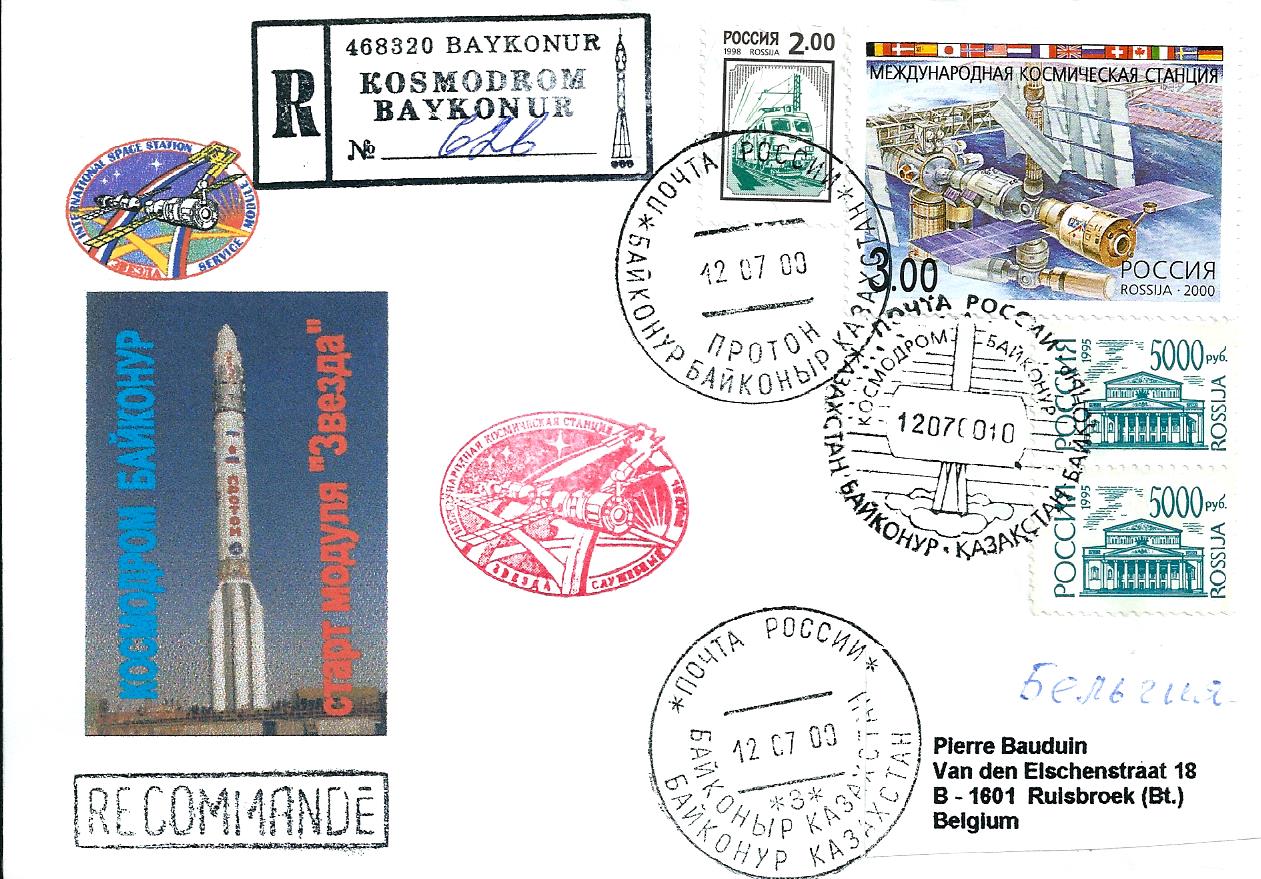 Launch cancel Baikonur, special red cancel. |
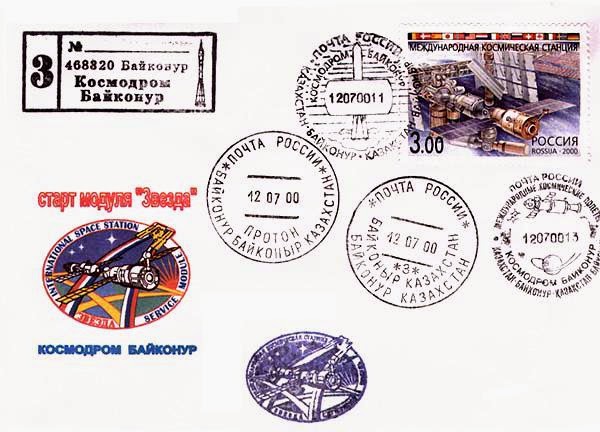 Launch cancel Baikonur, 4 different cancels. Credit: #402 |
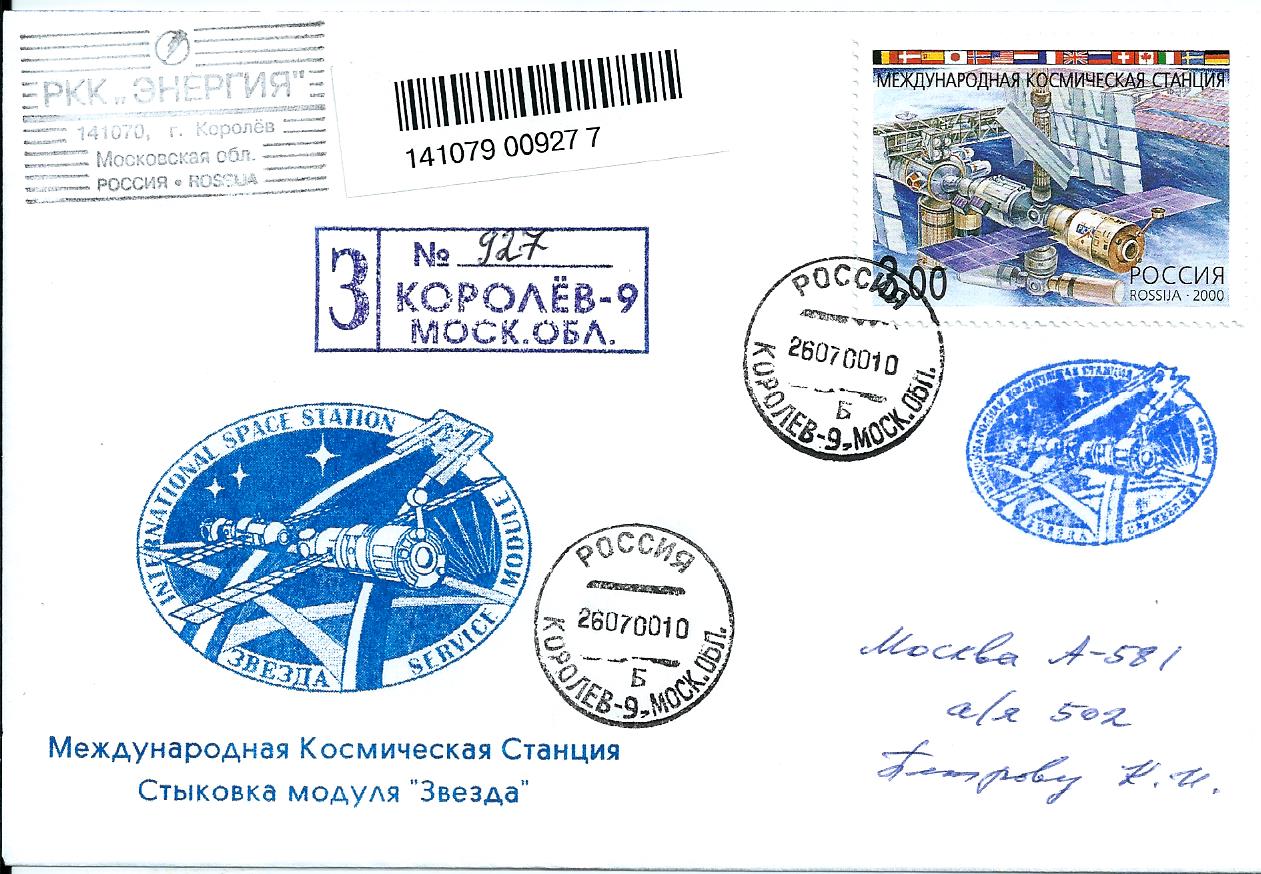 Docking cancel Korolev, send registrated. |
|
Ref.: #7(JR430), #21, #98, #206, #210, #401, #402 - update: 27.12.20
|
Home |


