Manned Flight n°: 199 |
Earth orbit Flight n°: 196 |
USA manned Flight n°: 116 |
Launch, orbit & landing data:
| Designation | 24849 / 97032A |
| Launch date - time | 01 Jul 1997 - 18:02:00 UT |
| Launch site | KSC, LC39A |
| Launch vehicle |
Space Shuttle |
| Orbiter | Columbia #23 (OV-102) |
| Primary payload | Spacelab LM 1 |
| Mass (kg) | |
| Flight Crew | Halsell, Still, Voss, Gernhardt
Thomas, Crouch, Linteris |
| Earth orbit on : |
| - Perigee / Apogee | 296 km |
| - Inclination | 28.45° |
| - Period | min |
| Landing date - time | 17 Jul 1997 - 10:46:34 UT |
| Landing location | KSC, Runway 33 |
| Flight Duration (d:hr:min) | 15d 16h 45m |
| Nbr orbits | 251 |
|
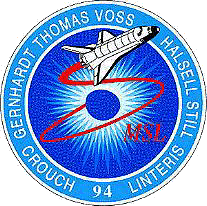
|
Crew
| Nr. |
Surname |
Given name |
Job |
Duration |
| 1 |
Halsell |
James Donald, Jr. |
CDR |
15d 16h 45m |
| 2 |
Still-Kilrain |
Susan Leigh |
PLT |
15d 16h 45m |
| 3 |
Voss |
Janice Elaine |
MSP |
15d 16h 45m |
| 4 |
Thomas |
Donald Alan |
MSP |
15d 16h 45m |
| 5 |
Gernhardt |
Michael Landon |
MSP |
15d 16h 45m |
| 6 |
Crouch |
Roger Keith |
PSP |
15d 16h 45m |
| 7 |
Linteris |
Gregory Thomas |
PSP |
15d 16h 45m |
Note:
STS-94 was the reflight, with the same equipment and crew, of the curtailed STS-83 mission.
Mission details:
Launch from Cape Canaveral (KSC); landing Cape
Canaveral (KSC); reflight of mission STS-83 (Microgravity Science Lab); 19
materials science invstigations in four major facilities; experiments with
flame balls.
Payload: Columbia F23 / Spacelab LM Unit 1 / EDO. Perigee: 296 km. Apogee: 300 km. Inclination: 28.5 deg. Period: 90.5 min.
Cargo Bay Payloads:
- MSL-1: The Microgravity Science Laboratory included the first test of the International Space Station’s EXPRESS Rack. MSL-1 also contained numerous other experiment payloads to test materials and combustion processes in zero gravity.
- CRYOFD: The Cryogenic Flexible Diode (CRYOFD) heat pipe was a Hitchhiker payload.
- OARE: The Orbital Acceleration Research Experiment was a self-calibrating instrument that monitored extremely small accelerations and vibrations experienced during orbit of the Shuttle.
In-Cabin Payloads: SAREX, MSX
The mission this time went for its full two week duration and the crew completed the full list of experiments. The deorbit burn was on July 17, 1997 at 09:44 GMT and Columbia landed on KSC's Runway 33 at 10:46:34 GMT.
Following a modified processing session at Kennedy Space Center, Columbia lifted off a little late (because of some clouds downrange), at 18:02:02 GMT. The RSRM-62 solid rocket motors separated at 18:04 GMT. The ET-86 external tank separated at 18:11:13 GMT leaving
Columbia in an elliptical transfer orbit which was circularized later by the OMS engines to a 296 x 301 km orbit inclined at 28.5 deg to the equator.
Development Test Objectives / Detailed Supplementary Objectives / Risk Mitigation Experiments
DTO 255: Wraparound DAP Flight Test Verification
DTO 312: External Tank TPS Performance
DTO 416: Water Spray Boiler Quick Restart Capability
DTO 667: Portable In-Flight Landing Operations Trainer
DTO 677: Evaluation of Microbial Capture Device in Microgravity
DTO 684: Radiation Measurement in Crew Compartment
DTO 805: Crosswind Landing Performance
DSO 331: Integration of the Space Shuttle Launch and Entry Suit
DSO 487: Immunological Assessment of Crewmembers
DSO 493: Monitoring Latent Virus Reactivation and Shedding in Astronauts
RME 1330: Wireless Data Acquisition System
Payload and vehicle weights: Orbiter (Columbia) empty and 3 SSME’s: 85,114 kg; Shuttle System at SRB Ignition: 2,051,646 kg; Orbiter Weight at Landing with Cargo: 117,806 kg; MSL-1 Spacelab Module: 10,169 kg; CRYOFD: 346 kg; OARE: 114 kg.
|
Ref.: #7, #8, #16 - update: 25.03.06
|
Home |