Manned Flight n°: 107 |
Earth orbit Flight n°: 104 |
USA manned Flight n°: 49 |
Launch, orbit & landing data:
| Designation | 15823 / 85048A |
| Launch date - time | 17 Jun 1985 - 11:33:00 UT |
| Launch site | KSC, LC39A |
| Launch vehicle |
Space Shuttle |
| Orbiter | Discovery OV-103 (#5) |
| Primary payload | Arabsat 1B/Telstar 3-D/Morelos 1 |
| Mass (kg) | |
| Call Sign | |
| Earth orbit on : |
| - Perigee / Apogee | km |
| - Inclination | 28.45° |
| - Period | min |
| Landing date - time | 24 Jun 1985 - 13:11:52 UT |
| Landing location | Edwards AFB, Runway 23 |
| Flight Duration | 7d 01h 38m |
| Nbr orbits | 112 |
|
|
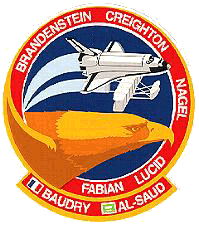
7 astronauts
Flight Crew
| Nr. |
Surname |
Given name |
Job |
Duration |
| 1 |
Brandenstein |
Daniel Charles |
CDR |
7d 01h 38m |
| 2 |
Creighton |
John Oliver |
PLT |
7d 01h 38m |
| 3 |
Lucid |
Shannon Matilda Wells |
MSP |
7d 01h 38m |
| 4 |
Fabian |
John McCreary |
MSP |
7d 01h 38m |
| 5 |
Nagel |
Steven Ray |
MSP |
7d 01h 38m |
| 6 |
Baudry |
Marie-Patrick Pierre Roger |
PSP |
7d 01h 38m |
| 7 |
Al-Saud |
Sultan bin Salman bin Abdulaziz |
PSP |
7d 01h 38m |
Mission details:
Launch from Cape Canaveral (KSC); landing on Edwards
AFB; deploying of three communications satelites Morelos-1 (Mexico),
Arabsat-1B (ASCO) and Telstar-3D (AT&T); deploying and retrieving of
US-platform SPARTAN 1-01 for astronomical studies; six Get Away Special
canisters with experiments in Earth observation, medicine, biology,
astronomy; two French biomedical experiments; SDI-experiment called High
Precision Tracking Experiment.
17 June 1985
11:31 GMT. LV Configuration: STS-25 (51-G). Spacecraft: Discovery. Payload: Discovery F05 /
Morelos 1[PAM-D] / Telstar 303. Mass: 20,174 kg. Perigee: 358 km. Apogee: 369 km.
Inclination: 28.5 deg. Period: 91.8 min.
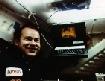 |
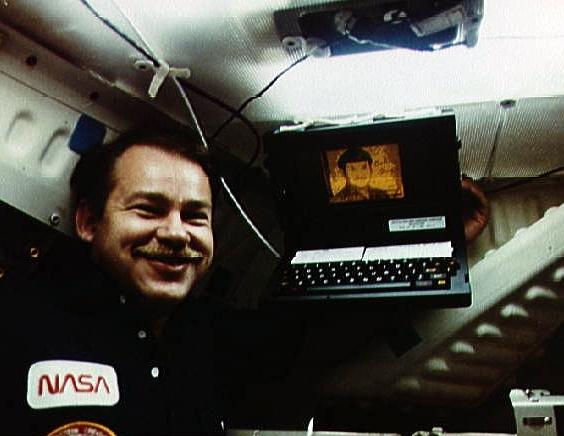
STS-51-G - Astronaut John Creighton poses with onboard GRID computer -
Credit: NASA. |
Deployed and retrieved Spartan 1; launched Morelos 1, Arabsat 1B, Telstar 3D.Payloads: Shuttle Pointed
Autono-mous Research Tool for Astronomy (SPARTAN)-1; Automated Directional Solidification Furnace (ADSF); High
Precision Tracking Experiment (HPTE); Orbiter Experiments (OEX); French Echocardiograph Experiment (FEE) and French Pocket Experiment (FPE).
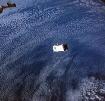 |
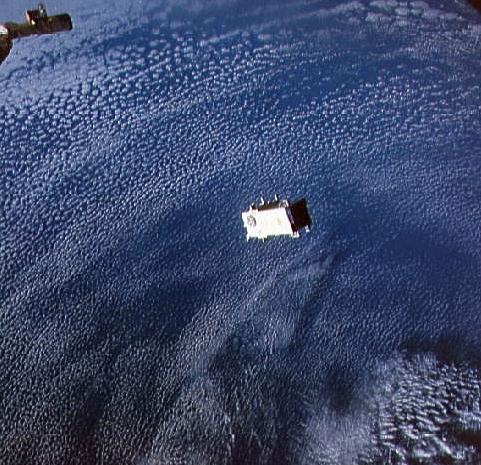
STS-51-G - Spartan 1 satellite moves away from orbiter over ocean - Credit:
NASA. |
Orbits of Earth: 111. Distance traveled: 4,693,051 km.
Orbiter Liftoff Mass: 116,310 kg. Orbiter Mass at Landing: 92,607 kg. Payload to Orbit:
20,174 kg. Payload Returned: 9,818 kg. Landed at: Runway 23 dry lake bed at Edwards Air Force Base, .
Landing Speed: 366 kph. Touchdown miss distance: 340 m. Landing Rollout: 2,265 m.
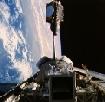 |
STS-51-G - Arabsat communications satellite deploying from Discovery's payload bay - Credit: NASA. |
NASA Official Mission NarrativeMission Name: 51-G (18)
DISCOVERY (5)
Pad 39-A (30)
18th
Shuttle mission
5th Flight OV-103
Crew:
Daniel C. Brandenstein (2), Commander
John O. Creighton (1), Pilot
Shannon W. Lucid (1), Mission Specialist 1
John M. Fabian (2), Mission Specialist 2
Steven R. Nagel (1), Mission Specialist 3
Patrick Baudry (1), Payload Specialist 1
Sultan Salman Al-Saud (1), Payload Specialist 2
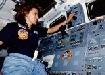 |
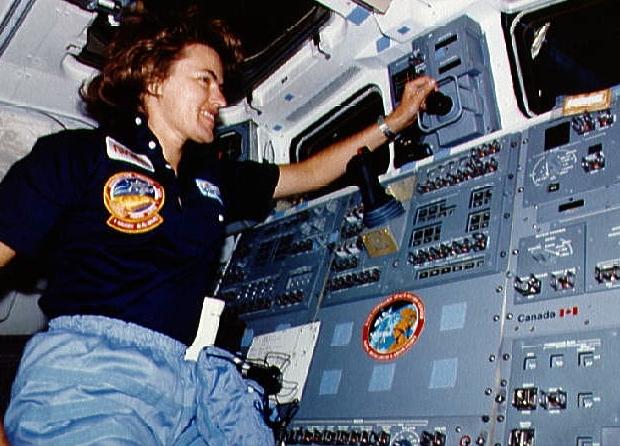
STS-51-G - Astronaut Shannon Lucid monitors payload bay activities -
Credit: NASA. |
Milestones:
OPF - April 19, 1985
VAB - May 29, 1985
PAD - June 4,1985 Payload:
MORELOS-A,ARABSAT-1B,TELSTAR-3D,SPARTAN-1,FEE,FPE,ADSF
Mission Objectives:
Launch:
Jun. 17,1985,7:33:00 a.m, EDT. Launch proceeded as scheduled with no delays. Launch Weight: 256,524 lbs.
Orbit:
Altitude: 209nm
Inclination: 28.45 degrees
Orbits: 112
Duration: Seven days, one hour, 38 minutes, 52 seconds.
Distance: 2,916,127 miles
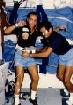 |
STS-51-G - Payload specialists Baudry and Al-Saud conduct Postural
experiment - Credit: NASA. |
Hardware:
SRB: BI-019
SRM: M018(HPM)
ET : 20/LWT-13
MLP : 1
SSME-1: SN-2109
SSME-2: SN-2018
SSME-3: SN-2012 Landing:
June 24, 1985, 6:11:52 a.m. PDT, Runway 23, Edwards Air Force Base, Calif. Rollout distance: 7,433 feet. Rollout time: 42 seconds. Orbiter returned to KSC June 28, 1985. Landing Weight: 204,169 lbs
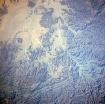 |
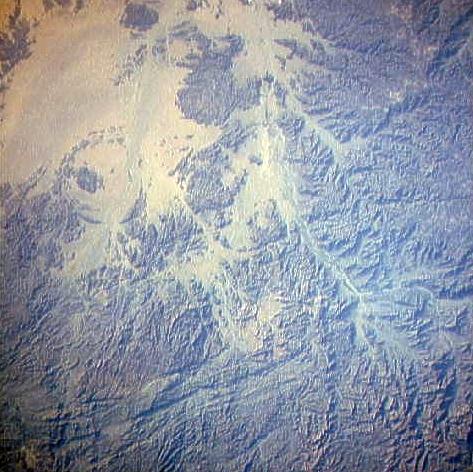
STS-51-G - Wadi Habawnah, Saudi Arabia - Credit: NASA. |
Mission Highlights:
Three communications satellites, all attached to Payload Assist Module-D (PAM-D) motors, were deployed: MORE LOS-A, for Mexico; ARABSAT-A, for Arab Satellite Communications Organization; and TELSTAR-3D, for AT&T. Also flown: deployable/retrievable Shuttle Pointed Autonomous Research Tool for Astronomy (SPARTAN-1); six Get Away Special canisters; Strategic Defense Initiative experiment called the High Precision Tracking Experiment (HPTE); a materials processing furnace called Automated Directional Solidification Furnace (ADSF); and two French biomedical experiments.
|
Ref.: #1, #6, #7,#8, #16 - update: 16.03.06
|
Home |