Manned Flight n°: 143 |
Earth orbit Flight n°: 140 |
USA manned Flight n°: 73 |
Launch, orbit & landing data:
| Designation | 21638 / 91054A |
| Launch date - time | 02 Aug 1991 - 15:02:00 UT |
| Launch site | KSC, LC39A |
| Launch vehicle |
Space Shuttle |
| Orbiter | Atlantis OV-104 (#9) |
| Primary payload | TDRS-5 |
| Mass (kg) | 16935 kg |
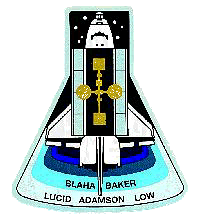
| Flight Crew | Blaha, Baker, Lucid, Low, Adamson |
| Call Sign | |
| Earth orbit on : |
| - Perigee / Apogee | km |
| - Inclination | 28.45° |
| - Period | min |
| Landing date - time | 11 Aug 1991 - 12:23:25 UT |
| Landing location | KSC, Runway 15 |
| Flight Duration (d:hr:min) | 8d 21h 21m |
| Nbr orbits | 142 |
|
|
Crew
| Nr. |
Surname |
Given name |
Job |
Duration |
| 1 |
Blaha |
John Elmer |
CDR |
8d 21h 21m |
| 2 |
Baker |
Michael Allen |
PLT |
8d 21h 21m |
| 3 |
Lucid |
Matilda Shannon Wells |
MSP |
8d 21h 21m |
| 4 |
Adamson |
James Craig |
MSP |
8d 21h 21m |
| 5 |
Low |
George David |
MSP |
8d 21h 21m |
Mission details:
Launch from Cape Canaveral (KSC); landing on Cape
Canaveral (KSC); deploying of communications satellite TDRS-E; 32
physical, material and life sciences experiments were
conducted.
02 August 1991
15:07 GMT. Duration: 8.89 days. Payload: Atlantis F09 / TDRS 5 [IUS]. Mass: 21,265 kg. Perigee: 301 km. Apogee: 306 km. Inclination: 28.5 deg. Period: 90.6 min.
Manned five crew. Deployed TDRS 5 satellite. Payloads: Tracking and Data Relay Satellite (TDRS)-E/lnertial Upper Stage (lUS), Space Station Heatpipe Advanced Radiator Element (SHARE)-ll, Shuttle Solar Backscatter Ultraviolet (SSBUV) instrument 03, Optical Communications Through the Shuttle Window (OCTW), Air Force Maui Optical Site (AMOS) Calibration Test, Auroral Photography Experiment (APE)-B, Bioserve-lnstrumentation Technology Associates Materials Dispersion Apparatus (BlMDA)-02, Investigations Into Polymer Membrane Processing (IPMP)-03, Protein Crystal Growth Ill Block Il, Space Acceleration Measure-ment System (SAMS), Solid Surface Combustion Experiment (SSCE)-02, Tank Pressure Control Experiment (TPCE).
Orbits of Earth: 142. Distance traveled: 5,955,216 km. Orbiter Liftoff Mass: 117,653 kg. Orbiter Mass at Landing: 89,235 kg. Payload to Orbit: 21,265 kg. Payload Returned: 4,192 kg. Landed at: Runway 15 at Kennedy Space Center, Florida. Landing Speed: 376 kph. Touchdown miss distance: 605 m. Landing Rollout: 3,014 m.
NASA Official Mission NarrativeMission Name: STS-43 (42)
Atlantis (9)
Pad 39-A (41)
42nd Shuttle mission
9th Flight OV-104
Scheduled KSC landing
8th KSC landing
Crew:
John E. Blaha (3), Commander
Michael A. Baker (1), Pilot
Shannon W. Lucid (3), Mission Specialist 1
James C. Adamson (2), Mission Specialist2
G. David Low (2), Mission Specialist 3
Milestones:
OPF - April 19,1991
VAB - June 19,1991
PAD - June 25,1991
Payload:
TDRS-E,SSBUV-03,SHARE-II,OCTW-01,TPCE
Mission Objectives:
Launch:
August 2,1991, 11:01:59 a.m. EDT. Launch originally set for July 23, but was moved to July 24 to allow time to replace a faulty integrated electronics assembly that controls orbiter/external tank separation. Mission postponed again about five hours before liftoff on July 24 due to a faulty main engine controller on number three main engine. Controller replaced and retested; launch reset for Aug. 1. Liftoff set for 11:01 a.m. delayed due to cabin pressure vent valve reading and postponed at 12:28 p.m. due to unacceptable return-to-launch site weather conditions. Launch reset for Aug. 2. Launch Weight: 259,374 lbs.
Orbit:
Altitude: 174nm
Inclination: 28.45 degrees
Orbits: 142
Duration: 8 days, 21 hours, 21 minutes, 25 seconds.
Distance: 3,700,400 miles
Hardware:
SRB: BI-045
SRM: 360L017
ET : 47/LWT-40
MLP : 1
SSME-1: SN-2024
SSME-2: SN-2012
SSME-3: SN-2028
Landing:
August 11, 1991, 8:23:25 a.m. EDT, Runway 15, Kennedy Space Center, Fla. Rollout distance: 9,890 feet. Rollout time: 60 seconds. First landing scheduled at KSC since 61-C in January 1986 (which was diverted to Edwards). Landing Weight: 196,088 lbs.
Mission Highlights:
Primary payload, Tracking and Data Relay Satellite-5 (TDRS-5) attached to an inertial Upper Stage (I US), deployed about six hours into flight, and IUS propelled satellite into geosynchronous orbit; TDRS-5 becomes fourth member of orbiting TDRS cluster. Secondary payloads were Space Station Heat Pipe Advanced Radiator Element II (SHARE II); Shuttle Solar Backscatter Ultra-Violet (SSBUV) instrument; Tank Pressure Control Equipment (TPCE) and Optical Communications Through Windows (OCTW). Other experiments included Auroral Photography Experiment (APE-B) Protein Crystal Growth Ill (PCG Ill); Bioserve / Instrumentation Technology Associates Materials Dispersion Apparatus (BIMDA); Investigations Into Polymer Membrane Processing (IPMP); Space Acceleration Measurement System (SAMS); Solid Surface Combustion Experiment (SSCE); Ultraviolet Plume imager (UVPI); and the Air Force Maui Optical Site (AMOS) experiment.
|
Ref.: #1, #7, #8, #16 - update: 20.03.06
|
Home |