Manned Flight n°: 83 |
Earth orbit Flight n°: 80 |
USA manned Flight n°: 34 |
Launch, orbit & landing data:
| Designation | 13106 / 82022A |
| Launch date - time | 22 Mar 1982 - 16:00:00 UT |
| Launch site | KSC, LC39A |
| Launch vehicle |
Space Shuttle (#3) |
| Orbiter | Columbia OV-102 (#3) |
| Primary payload | OSS-1 (160 kg) |
| Mass (kg) | 10301 |
| Call Sign | Columbia |
| Backup crew | |
| Earth orbit on : |
| - Perigee / Apogee | 241 / 249 km |
| - Inclination | 38.0° |
| - Period | 89.4 min |
| Landing date - time | 30 Mar 1982 - 16:04:46 UT |
| Landing location | White Sands, Runway 17 |
| Flight Duration | 8d 00h 04m |
| Nbr orbits | 130 |
|

|
Third test, White Sands landing delayed 1 day by storm.
Flight Crew
| Nr. |
Surname |
Given name |
Job |
Duration |
| 1 |
Lousma |
Jack Robert |
CDR |
8d 00h 04m |
| 2 |
Fullerton |
Charles Gordon |
PLT |
8d 00h 04m |
Mission details:
Launch from Cape Canaveral (KSC); landing at White
Sands; third test flight of the Space Shuttle; payloads included the OSS-1
pallet in the cargo bay of the shuttle; OSS-1 obtained data on near-Earth
environment; several other experiments (Monodisperse Latex Reactor, Heflex
Bioengineering Test and more); landing site changed from Edwards to White
Sands because of rainy weather; than high winds at White Sands resulted in
one-day extension of the mission.
 |
STS-3 - Air-to-air views of STS-3 launch from T-38 chase aircraft
- Credit: NASA. |
Manned two crew. Payloads: Office of Space Science (OSS) experiments, Monodisperse Latex Reactor (MLR), Electro-phoresis Verification Test (EEVT), Plant Lignification Experiment. First and only landing by a shuttle at White Sands, New Mexico, after weather at Edwards did not permit landing there.
 |
STS-3 - MOCR activity during STS-3 mission - Credit: NASA.
|
Reusable space transportation system.Orbits of Earth: 129. Distance traveled:
7,081,113 km. Orbiter Liftoff Mass: 106,782 kg. Orbiter Mass at Landing: 93,924 kg.
Payload to Orbit: 10,301 kg. Payload Returned: 10,301 kg. Landed at:
Runway 17 dry lake bed at White Sands Missile Rang. Landing Speed: 407 kph.
Touchdown miss distance: 332 m. Landing Rollout: 4,187 m.
 |
STS-3 - Pilot Fullerton dons anti-g and ejection escape suit
(EES) on middeck - Credit: NASA. |
NASA Official Mission NarrativeMission Name: STS-3 (3)
COLUMBIA (3)
Pad 39-A (15)
3rd Shuttle mission
3rd Flight OV-102
Extended mission
2nd RMS Mission
1st White Sands landing
 |
STS-3 - Night firing of orbiter Columbia's thrusters - Credit:
NASA. |
Crew:
Jack R. Lousma (2), Commander
C. Gordon Fullerton (1), Pilot Backup
Crew: (after STS-3, backup crews were no longer named)
Thomas K. Mattingly (1), Commander
Henry W. Hartsfield (0), Jr., Pilot
 |
STS-3 - Pilot Fullerton plans menu as packaged food and beverages
float around him - Credit: NASA. 66,057 bytes. 628 x 628 pixels. |
Milestones:
OPF - Nov. 26,1981
VAB - Feb. 3, 1982
PAD - Feb, 16, 1982 Payload:
OSS-1,DFI(3),MLR,EEVT,HBT,SSIP(x1),GAS(x1)
Mission Objectives:
Demonstrate safe re-launch and safe return of the orbiter and crew. Verify the combined performance of
the entire shuttle vehicle - orbiter, solid rocket boosters and external tank.
Payloads included
the 8,740lb Office of Space Science (OSS-1) Pallet consisting of the Plant Lignification Experiment,
the Plasma Diagnostic Package (PDP), the Vehical Charging and Potential (VCAP) experiment, the Space
Shuttle Induced Atmosphere experiment, the Thermal Canister experiment, the Solar Flare X-Ray
Polarimeter, the Solar Ultraviolet and Spectral Irradiance Monitor (SUSIM), the Contamination Monitor
Package and the Foil Microabrasion Package. Also in the payload bay was the 11,048lb Development Flight
Instrumentation (DFI) Pallet and the 448lb Aerodynamic Coefficient Identification Package (ACIP).
The crew compartment housed the Monodisperse Latex Reactor (MLR) experiment and the Heflex
Bioengineering Test (HBT) experiment.
 |
STS-3 - Commander Lousma examines Insect Flight Motion Study -
Credit: NASA. 57,191 bytes. 625 x 625 pixels. |
Launch:
March 22, 1982, 11:00:00 a.m. EST. Launch delayed one hour due to failure of heater on nitrogen gas
ground support line. Launch Weight: 235,415 lbs.
Orbit:
Altitude: 147nm
Inclination: 38.0 degrees
Orbits: 130
Duration: Eight days, zero hours. four minutes,
46 seconds.
Distance: 3,334,904 miles
 |
STS-3 - View of the Columbia's aft section while over Morocco's
Atlantic Coast - Credit: NASA. 35,048 bytes. 487 x 487 pixels. |
Hardware:
SRB: BI-003
SRM: 003SW(SPM)
ET : 4/SWT-3
MLP: 1
SSME-1: SN-2007
SSME-2: SN-2006
SSME-3: SN-2005 Landing:
March 30, 1982,9:04:46 a.m. MST, Runway 17,
Northrup Strip, White Sands, N.M. Rollout distance: 13,737 feet. Rollout time: 84 seconds. Landing site
changed from Edwards to White Sands due to wet conditions on Edwards dry lake bed landing site. High
winds at White Sands resulted in one day extension of mission, Some brake damage upon landing and dust
storm caused extensive contamination of orbiter. Orbiter returned to KSC April 6, 1982. Landing
Weight: 207,072 lbs.
 |
STS-3 - Pilot Fullerton eats on middeck - Credit: NASA.
|
Mission Highlights:
Testing continued of Space Shuttle systems for qualification for operational
flights. Testing of remote manipulator system and measurements of thermal response of orbiter in various
attitudes to sun conducted. Get Away Special test canister and Spacelab pallet-mounted experiments for
NASA's Office of Space Science- 1 (OSS-1) carried in payload bay. 0SS-1 obtained data on near- Earth
space environment, including contamination (gases, dust, etc.) introduced into space by orbiter itself.
Other experiments: Monodisperse Latex Reactor (MLR), Electrophoresis Equipment Verification Test (EEVT),
Heflex Bioengineering Test (HBT) and first Shuttle Student Involvement Program (SSIP) experiment.
Problems encountered: space sickness, malfunctioning toilet, thermostat difficulty and unexplained static
interfering with crew sleep. Auxiliary power unit registered overheating during ascent, but functioned
properly during descent. Three communications links lost.
 |
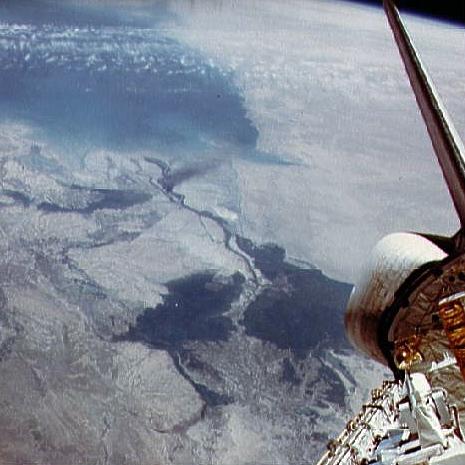
STS-3 - Payload bay, Northern Persian Gulf Region - Credit: NASA.
|
 |
STS-3 - Los Angeles, CA. - Credit: NASA. |
 |
STS-3 - Commander Lousma is surrounded by a week's worth of
trash on the middeck - Credit: NASA. 54,034 bytes. 599 x 599 pixels. |
 |
STS-3 - Commander Lousma sleeps on aft flight deck - Credit:
NASA. |
 |
STS-3 - Earth Limb and Hurricane Clouds over Open Ocean,
Location Unknown - Credit: NASA. 28,417 bytes. 472 x 472 pixels. |
 |
STS-3 - Air-to-air coverage of orbiter inspection during its
descent - Credit: NASA. 14,826 bytes. 527 x 527 pixels. |
 |
STS-3 - EMU TV system test - Credit: NASA. |
|
Ref.: #1, #7, #8, #16 - update: 21.02.05
|
Home |