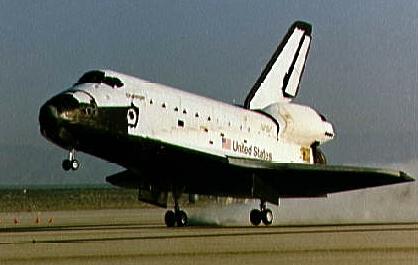
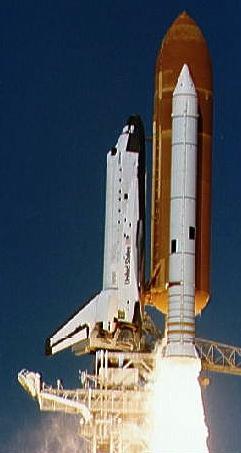
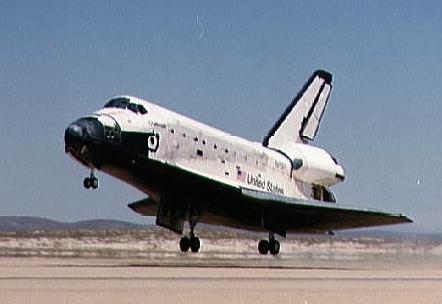
Module: Orbiter. Purpose: Manned space plane. Heat Shield Mass: 18,500 kg. Payload: 24,990 kg. Propellants: 21600 RCS Coarse No x Thrust: 38 x 395 kgf. RCS Fine No x Thrust: 6 x 11 kgf. RCS Propellants: N2O4/MMH. RCS Isp: 289 sec. RCS Total Impulse: 954,000.00 kgf-sec. Maneuver System Thrust: 24,213 kgf. Maneuver System Propellants: N2O4/MMH. Maneuver System Isp: 316 sec. Maneuver system delta v: 700 m/s. Electric system: 14.00 average kW. Electric System: 3,100.0 kWh. Electric system type: Fuel Cells.
 | Shuttle Orbiter - Shuttle Orbiter side view - Credit: © Mark Wade. 1,859 bytes. 402 x 158 pixels. |
Challenger joined NASA fleet of reusable winged spaceships in July
1982. It flew nine successful Space Shuttle missions. On January 28,
1986, the Challenger and its seven-member crew were lost 73 seconds
after launch when a booster failure resulted in the breakup of the
vehicle.
Challenger started out as a high-fidelity structural test article
(STA-099). The airframe was completed by Rockwell and delivered to
Lockheed Plant 42 for structural testing on 02/04/78. The orbiter
structure had evolved under such weight-saving pressure that virtually
all components of the air frame were required to handle significant
structural stress. With such an optimized design, it was difficult to
acurately predict mechanical and thermal loading with the computer
software available at the time. The only safe approach was to submit
the structural test article to intensive testing and analysis. STA-099
underwent 11 months of intensive vibration testing in a 43 ton steel
rig built especially for the Space Shuttle Test Program. The rig
consisted of 256 hydraulic jacks, distributed over 836 load
application points. Under computer control, it was possible to
simulate the expected stress levels of launch, ascent, on-orbit,
reentry and landing. Three 1 million pound-force hydraulic cylinders
were used to simulate the thrust from the Space Shuttle Main Engines.
Heating and thermal simulations were also done.
 | STS-6 - Deployment of the TDRS by STS-6 Challenger - Credit: NASA. 33,018 bytes. 420 x 437 pixels. |
Rockwell's original $2.6 billion contract had authorized the building
of a pair of static-test articles (MPTA-098 and STS-099 and two
initial flight-test vehicles (OV-101 and OV-102. A decision in 1978
not to modify Enterprise from her ALT configuration would have left
Columbia as the only operational orbiter vehicle so on 1/29/79 NASA
awarded Rockwell a supplemental contract to convert Challenger
(STA-099) from a test vehicle into a space-rated Orbiter (OV-099).
 | STS-7 - Air to air tracking views of the Challenger during launch of STS-7 mission - Credit: NASA. 25,395 bytes. 370 x 427 pixels. |
STA-099 was returned to Rockwell on 11/7/79 and it's conversion into a
fully rated Orbiter Vehicle was started. This conversion, while easier
than it would have been to convert Enterprise, still involved a major
disassembly of the vehicle. Challenger had been built with a simulated
crew module and the forward fuselage halves had to be seperated to
gain access to the crew module. Additionally, the wings were modified
and reinforced to incorporate the results of structural testing and
two heads-up displays (HUD's) were installed in the cockpit. Empty
Weight was 155,400 lbs at rollout and 175,111 lbs with main engines
installed. This was about 2,889 pounds lighter than Columbia
 | STS-7 - Challenger's RMS arm grasps SPAS-01 during proximity operations - Credit: NASA. 62,043 bytes. 487 x 401 pixels. |
Upgrades and Features
Two orbiters, Challenger and Discovery, were modified at KSC to enable
them to carry the Centaur upper stage in the payload bay. These
modifications included extra plumbing to load and vent Centaur's
cryogenic (L02/LH2) propellants (other IUS/PAM upper stages use solid
propellants), and controls on the aft flight deck for loading and
monitoring the Centaur stage. No Centaur flight was ever flown and
after the loss of Challenger it was decided that the risk was too
great to launch a shuttle with a fueled Centaur upper stage in the
payload bay.
 | STS-7 - Full view of Challenger in space taken by the SPAS satellite - Credit: NASA. 50,372 bytes. 591 x 379 pixels. |
Construction Milestones (MPTA-098)
07/26/72 Contract Award
06/24/75 Start structural assembly of aft-fuselage
07/12/76 Start of Final Assembly
05/27/77 Completed Final Assembly
04/21/78 Flight Readiness Firing
Construction Milestones (STA-099)
07/26/72 Contract Award
11/21/75 Start structural assembly of Crew Module
06/14/76 Start structural assembly of aft-fuselage
03/16/77 Wings arrive at Palmdale from Grumman
09/30/77 Start of Final Assembly
02/10/78 Completed Final Assembly
02/14/78 Rollout from Palmdale
Construction Milestones (OV-099)
01/05/79 Contract Award
01/28/79 Start structural assembly of Crew Module
06/14/76 Start structural assembly of aft-fuselage
03/16/77 Wings arrive at Palmdale from Grumman
11/03/80 Start of Final Assembly
10/23/81 Completed Final Assembly
06/30/82 Rollout from Palmdale
07/01/82 Overland transport from Palmdale to Edwards
07/05/82 Delivery to Kennedy Space Center
12/19/82 Flight Readiness Firing
04/04/83 First Flight (STS-6)
 | STS-7 - Full views of Challenger in space taken by the SPAS satellite - Credit: NASA. 59,606 bytes. 612 x 466 pixels. |