
V2
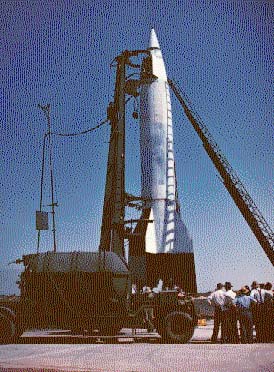
V2
In addition to material, captured German scientists and missileexperts were sent to the U.S. to assist in America's missile program.After careful screening, approximately 100 individuals were chosen tocome to this country. A paperclip was placed on their folders andthey became part of the program known as "Operation Paperclip."
The Paperclip crew, which was headed by the famous Dr. Wernher VonBraun, arrived in the U.S. on Nov. 17, 1945 and in January 1946 wasmoved to Fort Bliss, Texas. The group was divided and approximately20 were assigned to White Sands Proving Ground (WSPG). At the end ofa six-month period the Germans were returned to Fort Bliss forrenewal of contracts and reassignment. A few of the original groupwere returned to WSPG to continue work there.
German personnel at WSPG reached its peak of 39 in March 1946.Thereafter, the German specialists and engineers were replaced byAmerican contractor personnel in the spring of 1947.
The widespread impression that many German missiles were broughtto America intact and ready for flight was erroneous. No V-2s werereceived in flyable condition. The General Electric Company wascontracted by the U.S. Army Ordnance Department to assemble, test andfire the V-2s.
Despite the abundance of V-2 material brought to White Sandscertain components such as control compartment hardware were in shortsupply. For instance, only 50 control gyroscopes had been receivedfrom Germany, most of which were in poor condition. Each rocketrequired two gyroscopes. Another item which was found to beincomplete was a group of 70 electrical distribution panels with manyof them missing wiring.
During the later stages of the firing program, General Electricprovided gyros, mixer-computers, wiring, servo motors, and propellantpiping to replace those German parts missing or which haddeteriorated with age.
Major changes in configuration were made on 52 percent of the V-2slaunched from White Sands Missile Range (WSMR), and 71 percent wereabove designed weight. Empty weight of the standard V-2 was 8,000pounds which included 2,200 pounds of payload - warhead - and theaverage empty weight of all missiles launched was 9,218 pounds, anincrease of 19 percent in terms of payload.
By 1951 all V-2s launched had major contour modifications andcarried more than 47 percent added payload, bringing the maximumloaded weight to 28,400 pounds.
Assembling and testing V-2s were tedious jobs. Each rocketrequired days of preparation. All basic components were individuallyinspected for performance and condition prior to assembly. Repair andadjustments were made as required, and then they were tested again.Large subassemblies were completely tested before being installed andthen the completely assembled missile was given two over-all testsbefore it left the assembly building.
After the V-2 was assembled and tested, a German-made trailercalled the Meilerwagon towed it to the launch pad. An integral liftframe on the Meilerwagon elevated the rocket to a vertical positionon a low portable steel "launch table". The table incorporated ablast deflector, a mast for electrical wiring, and fittings forliquid propellant hoses.
At the launching site, one over-all test was made prior tolaunching day, and the same test was repeated immediately prior toloading the propellant on firing day. No connection could be brokenafter the final test was made. Following a thorough check of allcomponents, the rocket was fueled with alcohol and liquid oxygen.
The launch procedure included a final test of the rocket motor.Alcohol and liquid oxygen were allowed to flow into the combustionchamber by the force of gravity, where they ignited on contact. Thisproduced approximately 16,000 pounds of thrust, too little to movethe rocket but enough to check that the motor was functioningproperly. The propellent turbine was then activated, increasingthrust to 52,000 pounds, enough to immediately initiate a launch. TheV-2 had an overall length of 46 feet, diameter of 5 feet 5 inches,and a fin span of 11 feet 8 inches, its motor developed 52,000 poundsof thrust for 68 seconds, and its launching weight was 28,413 pounds,including 19,575 pounds of liquid propellant. The rocket consisted offive major parts:
Nose Cone - During World War II, the nose cone held aGerman warhead containing almost a ton of explosives. At White Sands,the Army invited government agencies and universities to use the nosecone's 20 cubic feet of space for scientific research, up to 2,000pounds of scientific equipment, such as cameras, sensors, andon-board experiments, were carried aloft on each flight.
Control Section - This section contained gyroscopes forguiding the rocket in flight and the bottles of nitrogen gas thatpowered them. The gyroscopes produced electrical signals in the formof voltage proportional to the amount of correction needed tomaintain a preset trajectory. The corrective signals were transmittedthrough an integrating computing element to steering vanes in thetail assembly.
Midsection - The propellant used in the V-2 consisted ofalcohol and liquid oxygen, propellant tanks and associated valves andpiping were located in the rocket's midsection. Glass wool insulatedthe rocket from the extreme cold of the liquid oxygen.
Thrust Frame - The thrust frame held the propulsion unit,which consisted of a turbopump, steam-generating plant, heatexchanger, combustion unit, and associated piping. The turbopump waspowered by steam generated from combining hydrogen peroxide andsodium permanganate, both of which were stored in tanks in thissection and forced into the pump by compressed air.
Tail Assembly - The tail served to stabilize flight andsteer the rocket, and consisted of the tail faring, four stabilizingfins with steering vanes, vane motors, and antennas.
In the entire experimental program, 68 percent of the V-2 flightswere considered successful. However, much valuable information wasgained from flights with known malfunctions and classified asfailures.
In all, 67 V-2 rockets were assembled and tested at White Sandsbetween 1946 and 1952, providing the U.S. with valuable experience inthe assembly, pre-flight testing, handling, fueling, launching, andtracking of large missiles. The scientific experiments conductedaboard the V-2 yielded significant information about the upperatmosphere, and one series of tests, the "Blossom Project," carriedout the first biological experiments in space. Landmark testsincluded:
Several offshoot programs developed from the V-2 experimentalprogram. They were the Bumper, Pushover andSandy.
In late 1946 Army Ordnance started a development program leadingto a two-stage rocket test vehicle. A WAC Corporal was mounted on thenose of a V-2 to form the first two-stage missile, known as theBumper. The first Bumper was launched May 13, 1948.
Operation Pushover concerned the deliberate explosion of a fullytanked V-2 on a dummy shipdeck at White Sands to determine its effecton shipboard launching.
Operation Sandy was the code name for launching a V-2 from thedeck of the aircraft carrier Midway. Preliminary tests were made andthe missile assembled at WSMR. On September 6, 1947, for the firsttime, a large rocket was launched from a ship at sea.
|
V2 |
V2 |